

To calculate your Ramp Slope , enter the following details given below:
Ramp Calculator with ADA
Ramp Parameters
Ramp Diagram
Reverse Ramp Calculator
Calculate a missing value given two known values.
Ramp Material Estimator
Estimate construction materials based on ramp dimensions.
2D Ramp Layout Generator
Visualize your ramp layout from a top-down perspective.
ADA Slope Reference Chart
| Application | Ratio | Slope % | Angle | Use Case |
|---|---|---|---|---|
| Comfortable ADA | 1:16 | 6.25% | 3.58° | Ideal for all users |
| Maximum ADA | 1:12 | 8.33% | 4.76° | Standard maximum |
| Minimum ADA | 1:20 | 5.00% | 2.86° | Gentle slope |
| Wheelchair Loading | 3:12 | 25.00% | 14.04° | Unoccupied vehicles only |
| Residential Assisted | 2:88 | 2.27% | 1.30° | Assisted living |
Quick Navigation:
What Is Ramp Slope?
Ramp slope is how steep a ramp is, the ratio of vertical rise to horizontal run. A ramp that rises 1 inch for every 12 inches of horizontal distance has a 1:12 slope. That sounds simple enough, but getting it precisely right is what separates a ramp that passes inspection from one that needs to be torn out and rebuilt.
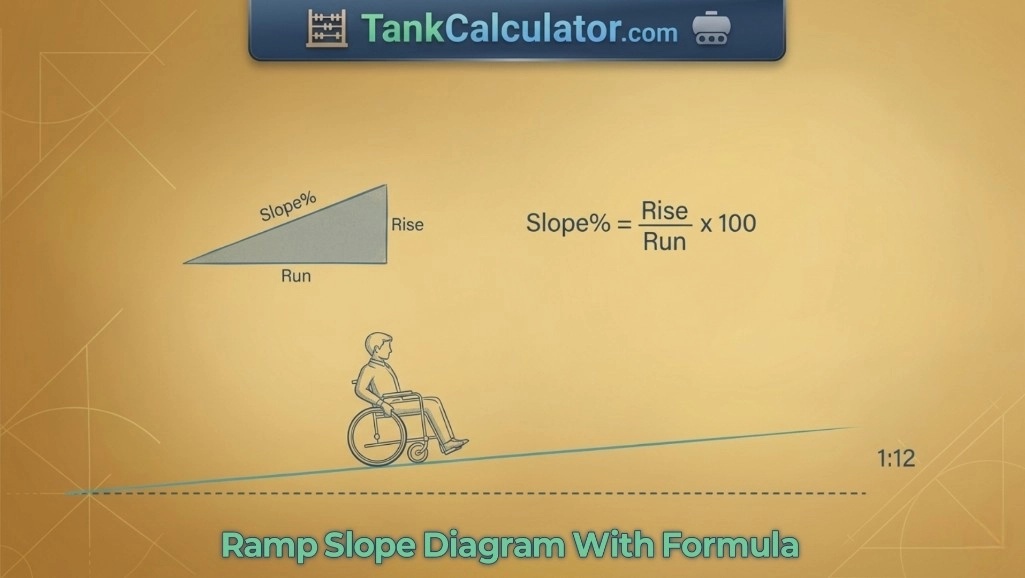
Slope shows up in three formats depending on who you’re talking to: as a ratio (rise:run), as a percentage (rise ÷ run × 100), or as an angle in degrees.
Ramp Slope vs Ramp Grade?
These two terms describe the same physical steepness, just in different notations.
Slope is typically a ratio like 1:12, while grade (or gradient) is a percentage like 8.33%.
They’re equivalent: divide the run by the rise to get the ratio denominator, or divide rise by run and multiply by 100 to get the percentage.
Why Ramp Slope Matters for Accessibility and Safety
The slope of a ramp has a direct, measurable impact on who can use it safely and independently. Too steep and wheelchair users can tip backward going up, lose control going down, or lack the upper body strength to self propel. For people using crutches, walkers, or prosthetics, a steep ramp adds stress on joints and raises fall risk considerably.
ADA Ramp Requirements and Standards
The Americans with Disabilities Act establishes specific technical standards which architects must follow when designing accessible ramps for new buildings and when they modify existing structures. The current federal standard for accessible design requires compliance with the ADA ramp standards from 2010.
- Maximum running slope: 1:12 (8.33%) This is for public and commercial construction.
- Maximum cross slope: 1:48 (approximately 2%). Side-to-side tilt beyond this causes wheelchair drift.
- Minimum clear width: 36 inches between handrails (some jurisdictions recommend 44 inches).
- Maximum rise per run segment: 30 inches. Rises beyond 30 inches requires an intermediate landing.
- Landing size: In this at least 60 × 60 inches at the top, bottom, and any direction change. Must be in level (max 1:48 cross slope).
- Handrails: This is Required on both sides whenever the rise exceeds 6 inches. The Gripping surface diameter: 1.25 to 2 inches.
- Edge protection: Curbs, walls, or wheel guides required along ramp edges in matter of protection of people.
Ramp Slope Calculation Methods and Formulas
The math behind ramp design isn’t difficult, but it requires getting several interconnected values right at the same time. Here are the core formulas used in the ramp calculations:
Core Ramp Slope Formulas
Slope Ratio:
Rise ÷ Run e.g: 4 ÷ 48 = 1:12
Slope Percentage:
(Rise ÷ Run) × 100 e.g: 8.33%
Angle in Degrees:
arctan(Rise ÷ Run) e.g: arctan(0.0833) ≈ 4.76°
Ramp Surface Length:
√(Rise² + Run²) actual distance along the slope
Required Run:
Run = Rise × Ratio Denominator e.g: 10-inch rise at 1:12 = 120-inch run
- Sections Required: Total Rise ÷ 30 inches (round up)
- Landings Required: Number of sections + 1
- Total elevation: (Rise) gain reaches 24 inches the maximum slope according to ADA standards requires a slope ratio of 1:12.
- The total distance: (Run) needed 24 × 12 = 288 inches (24 feet).
- The total sections required: Equals 1 because 24 ÷ 30 = 0.8 → 1 and (no intermediate landing needed)
- The surface length: Equals 289 inches because √(576 + 82,944) ≈ 289 inches.
Example:
- Total rise: 24 inches. Target slope: 1:12 (ADA maximum).
- Required run: 24 × 12 = 288 inches (24 feet)
- Sections: 24 ÷ 30 = 0.8 → 1 section
- Surface length: √(576 + 82,944) ≈ 289 inches
Common Ramp Slope Ratios (Rise:Run)
The table below covers the slope ratios most commonly used in accessible designs.
| Slope Ratio (Rise:Run) | Slope Percentage | Angle (°) | Use For |
|---|---|---|---|
| 1:20 | 5% | 2.86° | Easy entry points for outdoor paths |
| 1:16 | 6.25% | 3.58° | Meets ADA requirements with comfortable wheelchair access |
| 1:12 | 8.33% | 4.76° | Maximum slope allowed under ADA for new constructions |
| 1:10 | 10% | 5.71° | Used for existing sites and structural alterations |
| 1:8 | 12.5% | 7.13° | Residential or assisted use only |
| 1:6 | 16.67% | 9.46° | Too steep for ADA compliance |
| 1:4 | 25% | 14.04° | Utility paths with very steep gradient (not accessible) |
What Is a Ramp Slope Calculator?
A ramp slope calculator automates the design math for accessible and code-compliant ramps. You enter what you know (rise, run, or a target ratio) and it instantly returns slope ratio, percentage, angle, total surface length, required sections. When we are designing a handicap ramp slope it is really important to check if it meets the rules all the time. If we catch any mistakes when we are doing the calculations it will be a lot cheaper to fix them then. For ramp slope design checking everything in real-time is the best way to go.
How to Use TankCalculator’s Ramp Slope Calculator
- Step 1: Pick Your Mode: From given four tabs present
- Step 2: Set Units: inches, feet, centimeters, meters, or yards.
- Step 3: Then select preset type: Comfortable Access (1:16), ADA Maximum (1:12), Residential Assisted-Use, or a custom slope ratio.
- Step 4: Enter Your Known Dimensions: In Standard mode, enter the total rise and horizontal run. In Reverse mode, enter any two values and solve for the third.
- Step 5: Click the “Calculate Button”: This will provide you with an immediate answer after you click it.
About TankCalculator’s Ramp Slope Calculator
Our Ramp Slope Calculator is a purpose built, web based tool designed around ADA ramp slope and disabled ramp slope requirements.
This Calculator combines four integrated calculators (Standard Slope, Reverse, Material Estimator, and 2D Layout) with a live compliance engine, interactive diagrams, and a built-in ADA reference table. Each mode feeds results into the same compliance check, so whether you’re calculating from scratch or estimating materials for an existing design, the ADA verification always runs in the background. The disabled ramp slope compliance engine checks against multiple thresholds simultaneously: the 1:16 comfortable standard, the 1:12 ADA maximum, and applicable exceptions for existing structures.
This Ramp Slope Calculator was made to help with all kinds of ramp designs. For example a contractor can use it to figure out the cost of a ramp for a store entrance. A homeowner can also use it to check if a new backyard addition is okay with the residential rules. Our calculator is really helpful, for people who need to make sure their ramps meet the codes like the residential code.
Key Features of This Ramp Slope Calculator
- Four essential modes: Standard Slope, Reverse Calculator, Material Estimator, and 2D Layout Generator
- 2D diagram with color-coded rise, run, and surface length, 90° dog-leg, and 180° switchback ramp configurations
- Material quantities concrete volume (yd³), wood decking, steel grating weight, handrail length, asphalt all with built-in waste factors
- Step-by-Step explanation toggle the function displays complete procedural steps for every result.
- Built-in ADA reference chart no need to leave the page
- Calculation history the system provides immediate access to all past calculations which users can retrieve without needing to type their information again.
- Users can save their results as CSV files which they can use for record keeping or spreadsheet work or for permits, bids, and client reports.
Benefits of Using This Ramp Slope Calculator
The time savings alone are significant. Manual ramp calculations especially for multi-section ramps with unit conversions and ADA cross-references can take 30 to 60 minutes. This Ramp Calculator brings that down to under a minute, with fewer opportunities for arithmetic errors along the way.
The compliance first design establishes direct risk reductions for all project activities. Instant pass/fail indicators and safety warnings catch slope violations and max-rise errors before they reach the construction phase. The early warning system provides significant value to all ramps which require inspection or serve public spaces. Most online ramp calculators lack the material estimator because it provides essential functions which they do not offer. The upfront material requirements of concrete and decking and handrail design components enable more precise budget and material order calculations for both contractor bids and DIY building projects.
This Ramp Slope Calculator is useful for a time because you can print the results or export them as CSV. This makes the calculator helpful even after you are done with the design phase.
Frequently Asked Questions (FAQ)
What Are the Disadvantages of a Wheelchair Ramp?
Wheelchair ramps provide essential assistance, yet they need extra space than stairs which becomes necessary when the slope meets ADA standards. The installation process becomes challenging when there are limited spaces available. The construction costs of these ramps become high because the work involves building extended pathways which require handrails. Rain and snow can make ramps dangerous because they become slippery when maintenance tasks are not done properly.
What Is the Safe Gradient for a Ramp?
The ADA accessibility standards require wheelchair users to navigate from the 36 inches clear pathway width for wheelchair-friendly paths that have a safe slope of 1:12 , which means there should be 12 horizontal inches for every 1 vertical inch of height. The slope meets accessibility standards for wheelchair users who require safe and comfortable navigation.
What Is the Minimum Slope for a Disabled Ramp?
According to ADA guidelines, the standard minimum slope for disabled access ramps is typically 1:12. The slope requirements permit steeper angles for short ramps which exist in areas with space constraints yet the use of such ramps should be avoided in most situations.
What Are the Rules for DDA Ramps?
The DDA (Disability Discrimination Act) ramp regulations establish requirements to create safe accessible spaces. The primary guidelines require a gentle slope, which typically measures 1:12, together with double handrail installation and non-slip surface application and periodic resting areas through landings.
What Are the Common ADA Ramp Violations?
The most frequent ADA ramp violations occur when slopes exceed permitted steepness and handrails are either absent or installed incorrectly and there are no flat landing areas and the ramp width does not meet required standards.