

To calculate your arrhenius equation, enter the following details given below:
Arrhenius Equation Calculator by tankcalculator.com
| Temperature (K) | k | ln(k) | 1/T (K−1) |
|---|
Quick Navigation:
What Is the Arrhenius Equation?
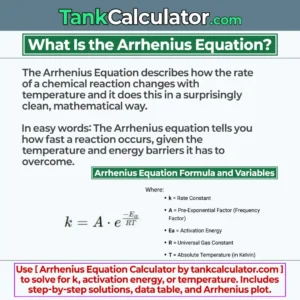
The Arrhenius Equation describes how the rate of a chemical reaction changes with temperature and it does this in a surprisingly clean, mathematical way.
Have you ever noticed that groceries spoil faster when it’s hot outside? This twist is related to the principle described by Arrhenius.
In easy words: The Arrhenius equation tells you how fast a reaction occurs, given the temperature and energy barriers it has to overcome.
Arrhenius Equation Formula and Variables
The full Arrhenius equation formula is:
k = A · e^(−Ea / RT)
Where,
- k denotes Rate Constant
- A denotes Pre-Exponential Factor (Frequency Factor)
- Ea denotes Activation Energy
- R denotes Universal Gas Constant
- T denotes Absolute Temperature
Linearized Form of the Arrhenius Equation: ln(k) vs. 1/T
The most practical form of the Arrhenius equation is probably its linearized form. If we take the natural logarithm of each side, we get:
ln(k) = ln(A) − (Ea/R) × (1/T)
This is a straight-line equation in the form y = mx + b, where:
- y = ln(k)
- x = 1/T
- slope (m) = −Ea/R
- intercept (b) = ln(A)
Additional Notation,
- ln = Natural logarithm
- 1/T = Reciprocal of temperature
- −Ea/R = Slope of the Arrhenius plot
- Arrhenius plot = Graph of ln(k) versus 1/T
This means taking experimental values of k and T, plotting ln(k) against 1/T, and therefore obtaining the activation energy (the slope of the graph) and the pre-exponential factor (from the y-intercept) from the resulting graph. This process is routinely performed in physical chemistry labs, and this calculator uses the same principle.
How to Calculate Using the Arrhenius Equation Manually
If you’re using a calculator it can still be useful to know the manual way. You might be able to check work and understand calculations more easily.
Calculate Rate Constant k from Ea and T
This is the most common calculation. Here’s how it works step by step:
1. Write down your known values: A, Ea (in J/mol), T (in Kelvin), and R = 8.314 J/mol·K.
2. Calculate the exponent: Divide −Ea by (R × T). This gives you a negative number.
3. Raise e to that power: Use e^x on your calculator. This value is always between 0 and 1.
4. Multiply by A: k = A × e^x. That’s your rate constant.
Example: A = 2.5 × 10¹³ s⁻¹, Ea = 75,000 J/mol, T = 300 K
k = 2.5×10¹³ × e^(−75000 / (8.314 × 300)) = 2.5×10¹³ × e^(−30.08)
This leads to a very low value of k, which was expected, because at 300 K most reactions with Ea around 75 kJ/mol are quite slow.
Calculate Activation Energy from The Arrhenius Equation
If you know two rate constants at two temperatures you can compute E without knowing A at all. The two temperature form is:
ln(k₂/k₁) = −(Ea/R) × (1/T₂ − 1/T₁)
Rearranging to solve for Ea:
Ea = −R × ln(k₂/k₁) / (1/T₂ − 1/T₁)
This is a standard experimental kinetic method. Run the reaction at two temperatures, find the rate constants at these two temperatures, and plug them into the equation. Mode 2 of the Arrhenius Equation Calculator does just that.
Find The Pre-Exponential Factor A
Once you know k, Ea, and T, finding A is just rearranging the equation:
A = k / e^(−Ea / RT)
Or in other words: using the Arrhenius plot, A = e^(intercept), the intercept here means that the value of ln(k) when 1/T=0. However, extrapolating can be not very accurate in practice, hence it is more dependable to calculate A from measured values directly.
How to Use TankCalculator’s Arrhenius Equation Calculator
- Step 1: Choose a Calculation Mode: The calculator has four modes, the one you want will depend on what you are trying to calculate.
Mode 1: Standard Arrhenius:
Use this when you know A, Ea, and T and you want to find the rate constant k. This is the most common use case it’s like you’re checking the equation straight.
Mode 2: Two-Temperature Method:
If you happen to have rate constants recorded at two different temperatures, say k₁ at T₁ and k₂ at T₂, this mode works out the activation energy Ea from those two numbers. It relies on a linearized version of the Arrhenius relation, you know where the famous straight-line trick comes from, and in that setup the prefactor A pretty much disappears entirely.
Mode 3: Rate Change with Temperature:
Enter Ea, two temperatures, and the rate constant you already know for one temperature then the calculator basically estimates the rate constant at the second temperature. It is useful if you’re trying to gauge how the reaction speed changes when you heat things up or lower the temperature.
Mode 4: Reverse Calculator (Auto):
This setting really is the most adaptable one. Just enter three of the four variables (k, A, Ea or T) and leave one variable out! This automatically knows what variable is needed, and calculates for it, at all! You are saved all the rearranging…
- Step 2: Enter the values and set units: Ensure your unit settings have been correct, Ea Unit, Temperature Unit, Decimal Precision, before you enter any number,
- Step 3: Gas Constant setting (optional): R is set as 8.314 J/molK. When R Unit selector is changed, R changes the value automatically.
- Step 4: Click the “Calculate Button”: This will provide you with an immediate answer after you click it
History of Arrhenius Equation
The equation is named after Svante Arrhenius, a Swedish physical chemist who proposed it in 1889. What Arrhenius was trying to explain were many years of observations by chemists: specifically, the way reaction rates increased so rapidly with temperature which could not be explained by collision theory alone.
His insight was to introduce the concept of activation energy: the idea that molecules need a certain threshold of energy before they can react, regardless of how often they collide.
Arrhenius received the Nobel Prize in Chemistry in 1903, partly for his work on electrolytic dissociation, but his rate equation has arguably had an even longer-lasting impact.
About TankCalculator’s Arrhenius Equation Calculator
Our Arrhenius Equation Calculator goes a bit more than most. It offers four modes of work, for the most typical Arrhenius tasks, like finding k straightforwardly, extracting Ea from two temperature sets, predicting how the rate constant shifts from one temperature to another, plus a reverse mode where it will automatically spot which variable is not provided, then solve for it.
It also prepares a temperature data table, draws the Arrhenius graph (ln(k) vs. 1/T) along with a regression line, and adds a live temperature slider so you can explore how k changes across a wide temperature span interactively. You can export the results as CSV, or just print them right away.
Key Features of TankCalculator’s Arrhenius Equation Calculator
4 modes of calculation: solves most typical Arrhenius equations for forward calculation, activation energy from 2 temperatures, rate calculation or reverse calculation.
Easy use of units: use any of J/mol, kJ/mol or eV for Ea; and Kelvin or degrees C for temperature. Gas constant is calculated automatically.
Step-by-step calculations: a calculation will be performed and every step shown to you so that you can verify how the answer is calculated.
Automatically generated data table: 13 row temperature table will be generated around the input temperature value for the calculation. T, k, ln(k) and 1/T are provided in the table.
Arrhenius plot: a ln(k) vs 1/T plot will be shown with best-fit line and labels for the slope and intercept.
Live temperature slider: you can play with the temperature to see how the rate change immediately.
Range check for Ea: warns you if your activation energy is outside the range that usually found in typical chemical reaction.
Input error checks: any illegal value such as negative temperature, zero rate constant, or division by zero will be notified to you.
Export to CSV file: the table generated can be exported to a CSV file so that it can be opened with Excel.
Benefits of Using an Arrhenius Equation Calculator
Saves time on repetitive calculations: Solving the Arrhenius equation once is easy enough. However, solving the Arrhenius equation 20 times at different temperatures and seeing what happens to the unit conversions isn’t easy. The calculator does this work for you, giving you a variety of answers instantly.
Reduces arithmetic errors: Mismatching the units of Ea (J vs. kJ) and R is also a classic mistake in calculations involving the Arrhenius equation. Eliminating the potential for error by using an internally controlled system for conversion and leaving R as is for a given system of units makes the calculator immune from that mistake.
Supports experimental data analysis: Mode 2 (the two-temperature method) can be used directly in a kinetics experiment if you specify two rate constants at two different temperatures and want to find the activation energy. The graph may also look like the graph you would draw in a practical physical chemistry lab, where plotting ln(k) versus 1/T gives a straight line with slope = −Ea/R.
Learning Tool: The step-by-step format helps transform this from a numbers-only tool into something you can learn from. If you calculated by hand, you can either double-check your work, find out where you made a mistake, or begin to understand how Ea and temperature are related.
All Arrhenius problems can be done this way: Almost all calculators do just k. One calculator does all four parameters, two temperature methods, and includes the tools for checking sensitivity to Ea and temperature that a teacher would expect in a classroom or research environment (sliders, plots, and tables).
Frequently Asked Questions (FAQ)
What is a weak Arrhenius base?
A weak Arrhenius base is a compound that increases the hydroxide ion, OH-, concentration by only a small amount when dissolved in water. As it only partially dissociates the increase in pH is only small. Ammonia in water is an example, in school it is often simplified to NH4OH.
What is the Arrhenius type factor?
The Arrhenius type factor typically refers to the frequency factor, represented as A in the Arrhenius equation. It tells us the frequency of suitable collisions per unit of time between reacting particles. Basically it explains why reaction rates vary with temperature and activation energy.
How does Arrhenius relate to pH?
Arrhenius is directly related to pH with acids and bases. Arrhenius acids increase the H+ ions, while Arrhenius bases increase the OH- ions. Since pH is related to the hydrogen ion concentration acids lower pH and bases increase it.
Is NH4OH a weak Arrhenius base?
Yes, NH4OH is generally treated as a weak Arrhenius base in school chemistry. It increases the OH concentration but to only a small amount and so only causes the pH to rise by a small amount. It is also a common simplification for ammonia in water.
Is NaHCO3 an Arrhenius base?
Yes, sodium bicarbonate, NaHCO3, acts as a weak Arrhenius base in water. It increases OH concentration slightly causing a mild basic solution. It’s certainly not a strong base but it acts like one slightly.
Is CO2 an Arrhenius base?
No, CO2 is not an Arrhenius base. When dissolved in water it forms carbonic acid which lowers the pH rather than increasing it by providing more OH- ions.