
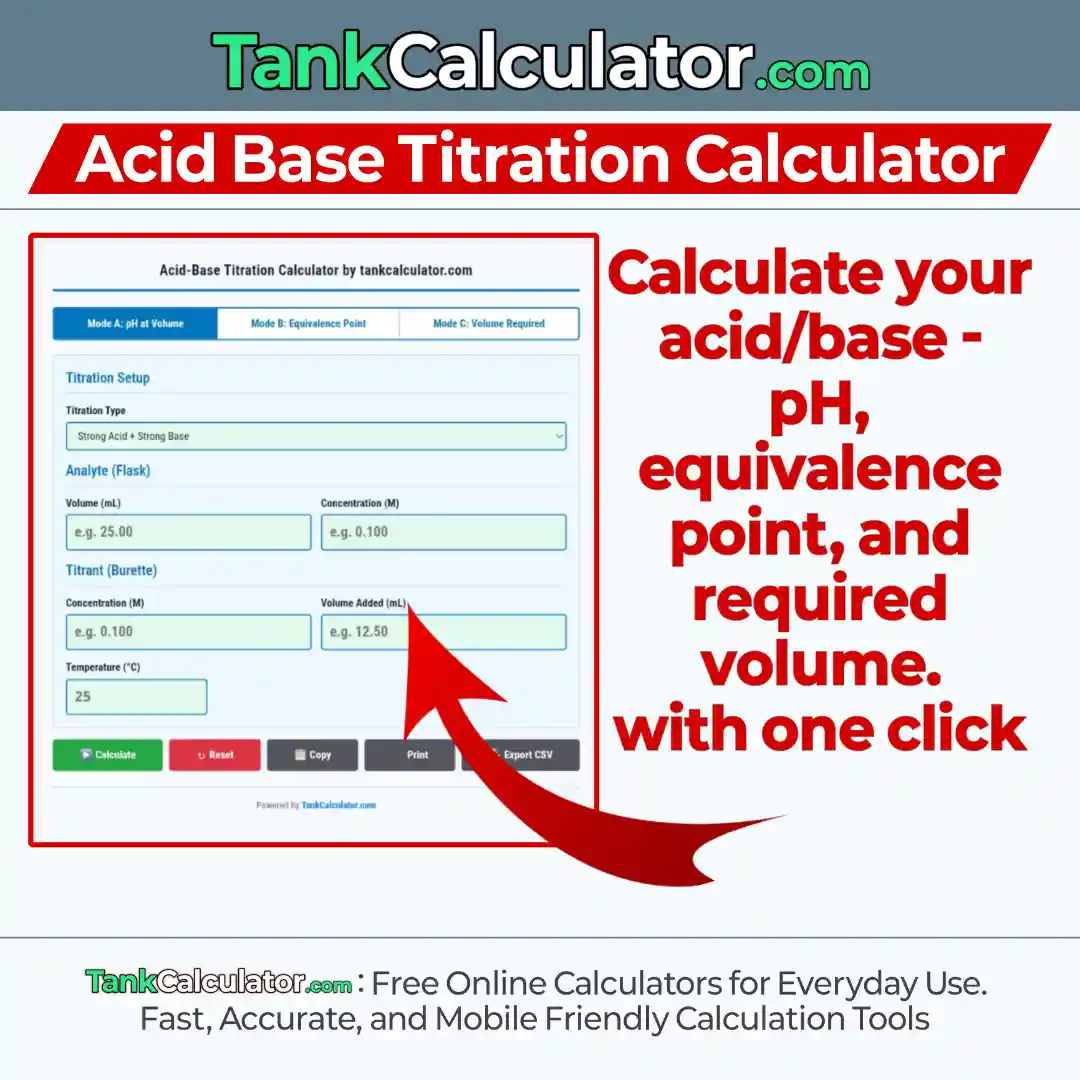
To find the concentration of an unknown acid or base, enter the following details given below:
Acid-Base Titration Calculator by tankcalculator.com
| Species / Parameter | Amount (mmol) | Concentration (M) |
|---|
How to Use TankCalculator’s Acid Base Titration Calculator
Step 1: Choose Your Test Type: Mode A: pH at Volume, Mode B: Equivalence Point, Mode C: Volume Required
Step 2: Select your titration type by drop-down menu.
Step 3: Enter the values like: concentration, volume, etc…
Step 4: Set the temperature in °C: defaults to 25°C if left blank (This is Optional).
Step 5: Click the “Calculate Button”: This will provide you with an immediate answer after you click it.
Quick Navigation:
What Is an Acid Base Titration?
If you’ve ever watched a burette drip a coloured solution into a flask until the liquid suddenly changes colour, So it means you’ve seen an acid-base titration in action.
An acid-base titration is a lab technique used to find the concentration of an unknown acid or base by reacting it with a solution of known concentration. The reaction is controlled added drop by drop until the acid and base have completely neutralised each other.
In chemistry, the acid-base titration definition comes down to this: it’s a quantitative method that uses the neutralisation reaction between an acid and a base to determine how much of one is present in a sample. The point at which the reaction is exactly complete is called the equivalence point. Most of the time, an indicator dye or a pH meter tells you when you’ve reached it.
Strong Acid + Strong Base Titration Explained
The simplest version is the strong acid strong base titration. Here, both the acid and the base fully ionise in water, so the math is relatively clean. The equivalence point lands at pH 7 at 25°C because the salt formed (like sodium chloride) doesn’t affect the pH at all.
Before the equivalence point, excess strong acid keeps the pH low. After it, excess strong base drives the pH high. The transition around the equivalence point is sharp pH can swing by several units with just a fraction of a millilitre of added titrant.
Weak Acid + Strong Base Titration Explained
In a weak acid strong base titration, the acid only partially ionises meaning it holds onto some of its protons unless forced to release them. Because of this, a buffer region forms before the equivalence point, where the pH changes only slowly with added base.
The equivalence point in this case is basic (pH above 7), not neutral. That’s because the conjugate base formed from the weak acid undergoes hydrolysis it reacts with water to produce a small amount of hydroxide. The pH at the equivalence point depends on the Ka of the weak acid, which is why you need it in the calculation.
Identifying the right indicator matters more here than in strong/strong titrations, since the equivalence point might land at pH 9 or 10 rather than 7.
Difference Between Acidimetry and Alkalimetry
The confusion between these two terms arises because both are related and very often used together.
- The analysis of acids using a standard base as the titrant is called acidimetry. Here, the acidity of the acid is being analyzed.
- On the other hand, the analysis of bases using a standard acid as the titrant is known as alkalimetry. In this case, the alkalinity of the base is measured.
Both acidimetry and alkalimetry are types of acid-base titrations; the only difference is what substance needs to be measured. The underlying principle and examples are the same: neutralisation, stoichiometry, and the equivalence point.
Acid-Base Titration Principle and Examples
The theory governing acid base titration is based on the fact that when an acid reacts with a base, there is always a definite ratio between their number of moles (in most cases, a ratio of 1:1 in case of monoprotic acids). When the equivalence point is reached, number of moles of both are equal.
A classic example: if you add 0.1 M NaOH from a burette to 25 mL of HCl until the phenolphthalein indicator turns pink, you’ve done an acidimetry titration. The volume of NaOH used tells you exactly how many moles of HCl were in the flask.
Example: 50 mL of 0.05 M H2SO4 (sulphuric acid) titrated with 0.1 M NaOH. Since H2SO4 is diprotic, 1 mole reacts with 2 moles of NaOH this is a case where the stoichiometry isn’t 1:1, and adjusting the calculation accordingly matters.
Types of Acid-Base Titrations
Some acids and bases act differently during titration. Depending on the pair, the curve shifts in form. The equivalence spot moves around too. Which indicator fits best depends on what kind of reaction unfolds. Four kinds of acid-base titrations exist. Each shows unique traits.
| Titration Type | Equivalence Point pH | Curve Shape |
| Strong Acid and Strong Base | Mostly neutral when warm. Around seven if room temperature hits twenty five degrees Celsius | Sharp bend near Ve |
| Weak Acid Meets Strong Base | >7 (basic) | A soft edge first, followed by a sudden change |
| Strong Acid Meets Weak Base | <7 (acidic) | After a slow build-up comes an abrupt edge |
| Weak Acid Meets Weak Base | Depends on Ka and Kb | Less pronounced inflection |
Strong Acid + Strong Base
Full ionisation on both sides. Clean neutralisation reaction; the equivalence point occurs at pH 7 at 25 °C. A straight and vertical portion of the graph near the equivalence point explains why a slight overshoot leads to a significant pH change.
Weak Acid + Strong Base
The ionisation of the weak acid is partial; therefore, a buffer region is observed. The equivalence point is basic due to the presence of a conjugate base (A⁻) that undergoes hydrolysis. To determine the pH of the equivalence point, one needs to use Ka.
Strong Acid + Weak Base
This situation can be viewed as a reflection of the previous case. There will also be a buffer region, and the weak base will be converted to its conjugate acid (BH⁺). The equivalence point is acidic; to find its pH value, one needs to know Kb (equivalently, Ka of the conjugate acid).
Weak Acid + Weak Base
Partial ionisation occurs on both sides of the equation; therefore, the graph is flattened. There is no inflection point at the equivalence point, and the exact calculation of pH in this case is difficult. However, there is an approximation formula (pH ≈ 7 + ½(pKa − pKb)).
Acid Base Titration Manual Formula and Calculations
Without calculators and other software, chemists solved titration calculations manually before their development. Understanding the manual calculation helps you understand the underlying principles of the tool.
The M1V1 = M2V2 Formula Explained
The most popular formula for solving titrations problems is:
M1V1 = M2V2
Where:
- M1 and M2 represent the concentrations of the two solutions
- V1 and V2 are their volumes.
The M1V1 = M2V2 formula applies perfectly to 1:1 titrations such as HCl + NaOH. It states that the moles of acid equals the moles of the base at the equivalence point.
However, if the titration involves different stoichiometry, say H2SO4 + 2NaOH, we modify the formula to M1V1 × n1 = M2V2 × n2 where n is the number of moles of H+ or OH- ions in the reaction.
Formula for pH at a Given Volume
Calculating pH mid-titration not just at the equivalence point requires tracking exactly how much acid and base have reacted. Below is the general approach for a weak acid titrated with a strong base:
- Before any base is added: solve the quadratic x² + Ka·x − Ka·Ca = 0 for [H⁺], then pH = −log[H⁺].
- In the buffer region (before equivalence): use Henderson–Hasselbalch: pH = pKa + log([A⁻]/[HA]).
- At half-equivalence: pH = pKa (this is where the buffer capacity is highest).
- At equivalence: all HA has become A⁻. Kb = Kw / Ka, then solve for OH− concentration. After finding OH−, calculate pOH = −log[OH−], and finally calculate pH = 14 − pOH.
- After equivalence: only the excess strong base contributes; pH = 14 + log([OH⁻]excess), finally pH = 14 − pOH.
Equivalence Point Calculation in Titration
The equivalence point volume is the most fundamental calculation in titration stoichiometry:
General formula:
Ca × Va × na = Ct × Ve × nt
Rearranged for equivalence volume:
Ve = (Ca × Va × na) / (Ct × nt)
Where:
- Ca = concentration of analyte
- Va = volume of analyte
- Ct = concentration of titrant
- Ve = equivalence-point volume
- na = acidic/basic equivalents of analyte
- nt = acidic/basic equivalents of titrant
For simple 1:1 titrations, the equation simplifies to:
Ve = (Ca × Va) / Ct
This is how we know the amount of titrant required for the equivalence point. The volume equation forms the basis for many other calculations.
Formula for Volume Needed for Desired pH
For desired pH instead of complete neutralization, we do the calculation in reverse order. If you need a particular pH within the buffer zone of a weak acid solution, then
- Calculate the [A⁻]/[HA] ratio using Henderson-Hasselbalch, and
- Use stoichiometry to determine the required volume of the titrant.
Outside of the buffer zone, bisection or iteration method is mostly used, and that’s what Mode C of the calculator employs.
What is an Acid Base Titration Calculator
An Acid Base Titration Calculator is a computerized chemistry calculator that determines automatically the pH and the equilibrium changes occurring during an acid-base titration. Instead of having to work out long equations once you have filled in the values of concentration, volume and acid/ base strength you are able to let the calculator ‘do the work’ for you.
About Tankcalculator’s Acid Base Titration Calculator
Titration is an example of a laboratory technique that is simple enough in theory but becomes complicated very quickly when you start working with weak acids, buffer zones, or temperatures other than 25 degrees Celsius. The Acid Base Titration Calculator is designed to take care of all these factors, Our calculator calculates five varieties of titration and provides both the pH value and the underlying chemistry behind it.
Basically, what the calculator does is that it performs calculations for all stages of titration, including initial solution, buffer zone, half-equivalence point, equivalence point, and excess above the equivalence point. When it comes to weak acid base systems, it does so by applying the correct approach to quadratics and the Henderson-Hasselbalch equation rather than using the approximate one. The Kw value will be adjusted for the temperature as well, so results stay accurate whether you’re working at 25°C or somewhere outside that standard assumption.
It not just calculates pH, it also draws a full titration curve, shows a mole balance table, recommends a suitable indicator, and exports your data to CSV.
Our calculator offers three calculation modes:
Mode A: pH at Volume: Input a volume of titrant used to determine the pH at that precise volume, and obtain information such as titration zone, ionic concentration, mole balance, and complete titration graph.
Mode B: Equivalence Point: Skips the volume entry and calculates directly at the equivalence point both the volume required (Ve) and the pH there.
Mode C: Volume Required: Works in reverse. Enter a target pH and the calculator finds the titrant volume needed to reach it, using a bisection algorithm for accuracy within ±0.0005 pH units.
Titration Types Supported
The calculator handles five distinct systems each with its own chemistry:
Strong Acid + Strong Base: the most straightforward case; equivalence point is neutral (pH 7 at 25°C).
Weak Acid + Strong Base: includes buffer region modelling using Henderson–Hasselbalch, and a basic equivalence point due to conjugate base hydrolysis.
Strong Acid + Weak Base: acidic equivalence point; the tool calculates Ka of the conjugate acid from Kw/Kb.
Weak Base + Strong Acid: titrant is the acid; works through the B/BH+ buffer system.
Weak Acid + Weak Base (approximation): uses the pH ≈ 7 + ½(pKa − pKb) formula, flagged clearly as an approximation.
You can enter Ka and Kb either directly or as pKa/pKb there’s a toggle button for each to switch between the two without re-entering your value.
Features of TankCalculator’s Acid Base Titration Calculator
Real Chemistry, Not Shortcuts: The pH calculations use proper equilibrium models throughout quadratic solving for initial weak acid/base conditions, the Henderson-Hasselbalch equation in the buffer region, and the Kb=Kw/Ka conjugation relation in the equivalence point. Correction factor for Kw based on temperature is also considered (−0.033 for every 10°C increase from 25°C).
Interactive Titration Curve: Once you calculate, our calculator will plot an interactive graph showing how pH changes with respect to volume, based on 120 data points up to 2.2 times the equivalence volume. The chart will feature labeled indicators at the beginning, half-equivalence, and equivalence points; shaded areas for buffer zones; and reference lines for pH 7 and Ve. It’s actually helpful in determining how close you are to reaching the equivalence point on the graph.
Mole Balance Table: In every result you get a species table , with the main chemical forms, the amounts in mmol and also the molar concentrations. It makes it a lot simpler to check the math by hand, or to talk through the outcome with someone else, which is especially useful if you’re doing teaching stuff.
Indicator Recommendation: This calculator also points you toward the most suitable common indicator for your equivalence point pH, chosen from a set of seven indicators (Methyl Violet through Alizarin Yellow). It will mention when the fit is only approximate, and in those cases it recommends you double check with a pH meter too.
Ka/pKa and Kb/pKb Toggle: You can enter your weak acid or base constant either as Ka (e.g. 1.8×10⁻⁵ for acetic acid) or as pKa (e.g. 4.74). A toggle button switches between the two without clearing your input. Same for Kb/pKb.
3 Calculation Modes: Mode A calculate pH at a given volume. Mode B calculate equivalence point directly. Mode C determine the volume which provide a certain pH value by a bisection search algorithm with 100 iterations so that the error could reach up to 0.0005pH units.
Export and Sharing Methods: Calculated results copied as text to clipboard. Export to CSV file, which contains all input values and output values. The input data in CSV file are useful for records in labs and coursework.
Benefits of TankCalculator’s Acid Base Titration Calculator
Saves Time on Complex Equilibrium Problems: In manual computation of the equivalence point in a weak acid solution, quadratic equations, Kw adjustments, and conjugate base calculations are required, which may lead to mistakes and are difficult to detect. The use of the calculator will simplify the process since it will perform all these computations automatically.
Applicable Regardless of Expertise Level: Students will benefit from looking at the process together with the pH number, thus having an understanding of what is going on at each titration stage chemically. Experienced chemists or lab technicians will have a rapid verification tool, particularly useful when dealing with the more exotic cases such as SA_WB or WB_SA, where it can be confusing chemically speaking.
Temperature-Aware Results: Most online calculators for titration assume 25°C as the temperature without any provision to alter it. However, the calculator used in this experiment modifies Kw with respect to the temperature you enter, thus creating an impact in cases where the solution temperature is not standard.
Visual Feedback Through the Titration Curve: The titration curve is drawn for your actual inputs, not a generic example. This means you can see the buffer region’s width, how steep the equivalence point inflection is, and whether you’re adding titrant in a region where pH is sensitive or relatively flat. That visual context is often more informative than the number alone.
Indicator Guidance Reduces Practical Errors: Choosing the wrong indicator is one of the more common practical mistakes in acid-base titrations particularly in weak acid or weak base systems where the equivalence point pH isn’t near 7. The built-in recommendation, based on pH range matching, gives you a sensible starting point for indicator selection.
Reverse Calculation for Experimental Planning: The Mode C bisection search is especially useful for experimental design instead of data analysis. If you need to buffer a solution to a certain pH level, you will know precisely how much titrant you require before you begin, instead of using trial and error during the actual experiment.
Frequently Asked Questions (FAQ)
Is pH 1-7 acidic or basic?
1-6 is acidic and pH 7 is neutral, so if you are referring to the range of 1-7 you would be including acidic and neutral. Essentially, below 7 is acidic, 7 is neutral and above 7 is basic.
Is pH 3 strong or weak?
3 is acidic. ‘Weak’ and ‘strong’ are terms that describe the chemical and are rarely used when describing pH. A solution at pH 3 would be reasonably acidic.
Is pH 10 strong or weak?
pH 10 is basic , and often people say alkaline too. But the words “strong” and “weak” are more for the substance itself, not just for the pH number, by itself. So when you see pH 10, you can tell it is basic, still you can’t directly conclude from that alone whether the base is strong , or more feeble than that.
What happens if pH is too low?
If the pH is too low, the solution starts being quite acidic. That acidity can become corrosive or irritating, even harmful depending on what material, or which system you are dealing with. Also in chemistry, a very low pH can shift reaction speeds, mess with instruments and equipment, and disturb biological systems as well.
How do you titrate Na2CO3 and NaHCO3 with HCl?
You then titrate this with standard HCl, the reaction occurs in two stages in the case of sodium carbonate. It first forms NaHCO3 and then carbonic acid, and finally carbon dioxide. NaHCO3 reacts in one step with HCl. In practice phenolphthalein and methyl orange indicators are used to determine the endpoints.