
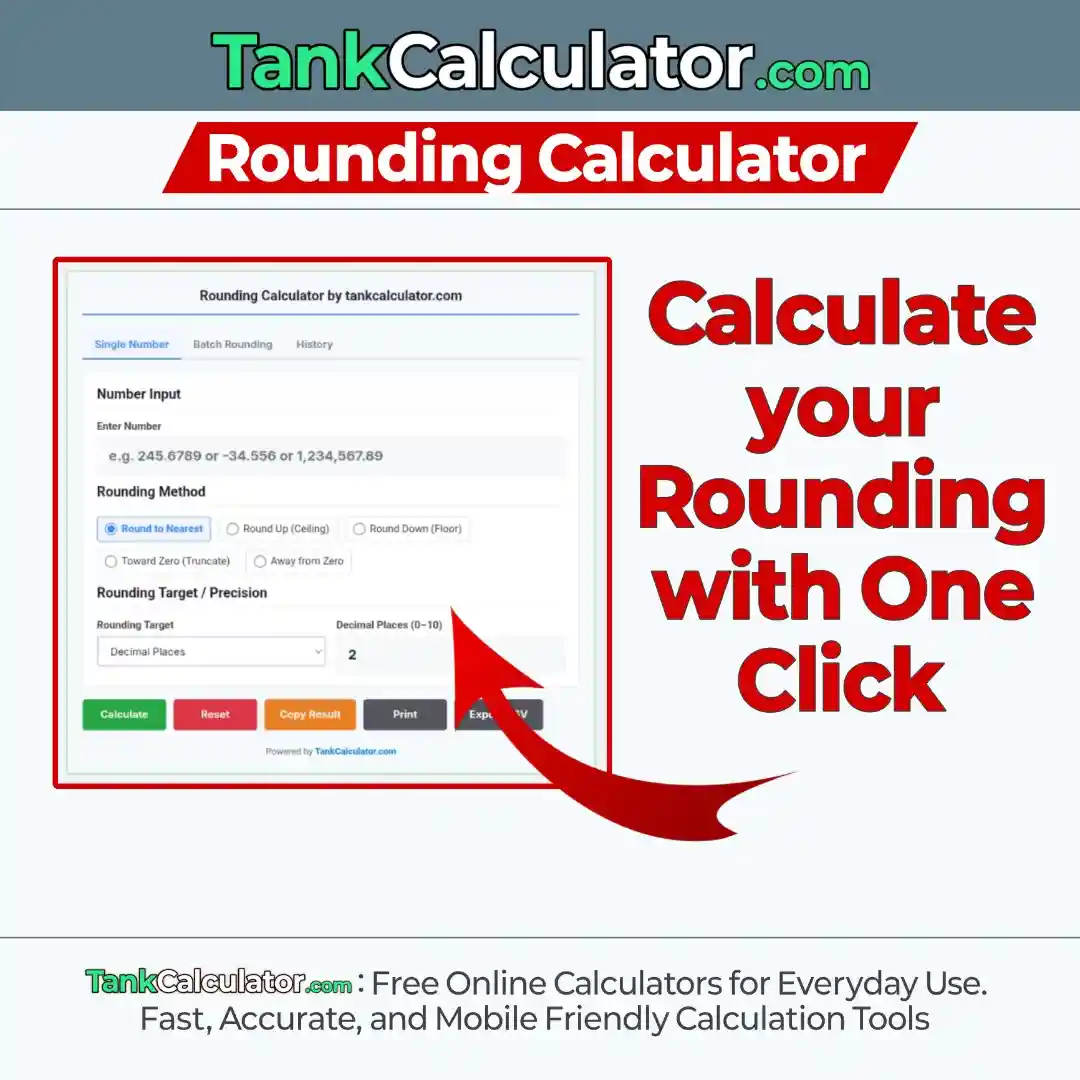
To calculate your digits, enter the following details given below:
Rounding Calculator by tankcalculator.com
Number Input
Rounding Method
Rounding Target / Precision
Result
Batch Number Rounding
Enter one number per line. All rounding settings from the Single Number tab apply.
Batch Results
Calculation History (Last 10)
No calculations yet.
What Is Rounding?
The ability to round numbers serves as a vital mathematical skill which people use throughout their daily activities but they frequently underestimate its importance. Rounding in mathematics serves as a method to transform precise numerical values into basic approximate values which meet your requirements. You should express the project cost as approximately €4,900 for common situations or as €5,000 for more precise requirements instead of stating that it costs €4,873.47.
Mathematics uses rounding as a basic process which reduces digit count in numbers while maintaining their original value for maximum accuracy. You make the number more accessible for work but your action does not change its original meaning. Rounding requires you to choose between ten nearest two rounding options or whole number rounding or specific decimal place rounding which all share the same goal of achieving simplification with minimal accuracy loss.
People begin to learn rounding numbers during their first school years but they need this ability throughout their adult lives to manage financial matters and construction projects and prepare meals and handle routine discussions. The math concept operates behind the scenes to influence a substantial portion of actual decision-making processes within the world.
Why Do We Round Numbers?
The process of rounding decimals and whole numbers provides multiple advantages which extend beyond its function of simplifying mathematical calculations.
The first factor which needs to be addressed involves how easily people can read the number. The number 3.141592653 provides correct information yet it presents difficulties for people to pronounce. The number 3.14 presents the same essential information as the original number but in a way that people can comprehend better. Rounding numbers becomes necessary because people need to use numbers that exist in their daily life through conversations and official documents and public presentations.
The process of rounding creates a solution for dealing with measurement restrictions which exist in the world. Rulers possess a maximum level of measurement accuracy beyond which they cannot go. Scales do not provide measurements which reach the millionth decimal point. Rounding exists as a method which people use to show their true measurement limits because they assume that their measurement will have more exact results than the actual measurement permits.
Different industries which include engineering accounting and data science have established standards or regulations to define its required number reporting practices. Everybody needs to learn the correct rounding process because it serves as a fundamental professional competency.
The final element which we need to discuss involves speed. The process of rounding enables you to achieve immediate results when you work on budget verification or estimate project expenses or perform quick mental calculations. Certain situations require exact precision yet most daily tasks can proceed efficiently with a number that has been properly rounded.
What Is a Rounding Calculator?
A rounding calculator is a calculator that automates the rounding process, saving you from having to apply rounding rules manually every time. Instead of working through each step in your head or on paper you simply enter a number, choose your method and precision, and get the result instantly.
A basic calculator provides direct results while a rounding calculator delivers extra functions through its mathematical rounding methods which users can control. The available rounding options include decimal place rounding, significant figure rounding, ceiling and floor function rounding, and custom step increment rounding. The design of the tool provides users with a specific solution to complete their defined task.
How to Calculate Using This Calculator
- 1. Enter a number in the input field (in decimals, negatives, and comma separated values)
- 2. Choose a suitable rounding method such as nearest, up, down, or others
- 3. Select the rounding target (decimal places, place value, significant figures, or custom step)
- 4. Input the required precision value based on your selection
- 5. Tap the Calculate Button this the calculate button this will provide you with an immediate answer after you click it.
Review the result, step by step explanation, and number line visualization. For multiple values, switch to batch mode and enter numbers line by line
About TankCalculator’s Rounding Calculator
Our Rounding Calculator provides users with an efficient tool which enables them to execute precise rounding tasks through various mathematical techniques and different levels of precision within a single interface. The tool maintains its reliability as users process both single numbers and multiple values throughout their work.
The program enables users to round numbers according to their desired decimal places, base value positions, important digits, and personal step size selections. The tool processes both individual and bulk inputs while maintaining accuracy across the board.
Key Features of TankCalculator’s Rounding Calculator
- Multi-Method Rounding System: Supports nearest, ceiling (up), floor (down), truncate (toward zero), and away from zero. Different jobs call for different rounding approaches, and this covers them all.
- Number Types and Precision: You can generate whole integers or decimals, and for decimal outputs, precision is adjustable from 0 to 10 decimal places.
- Batch Processing Capability: You can switch to batch mode and enter values one by one to work with whole lists at the same time. This Batch Processing Capability is really helpful.
- Step by Step Breakdown: You get a Step by Step Breakdown of what was done to get the answer.
- Visual Number Line Representation: There is a display that shows where the original number is compared to the rounded result. This Visual Number Line Representation makes it easy to understand.
- Export and other Options: You can copy them. Download them as CSV files. You can even print them directly. This makes it easy to use your results in ways.
- History: The system remembers your 10 results.
Benefits of Using a Rounding Calculator
The dedicated rounding calculator functions as a valuable tool because it provides actual, beneficial functions for rounding tasks.
The most obvious one is speed. The process of rounding values by hand becomes easier when you have fewer values to handle and fewer rounding techniques to use. The automated system allows you to work with your actual duties while it handles all number processing work.
The second major element of the system is accuracy. Manual calculations introduce errors, particularly when you’re tired, distracted, or working with unfamiliar rounding conventions like significant figures or custom increments. A well-built calculator eliminates that variability entirely.
The learning benefit for students exists as a real advantage. The process of seeing each step which led to the number rounding result enables students to build understanding of it over time. The difference exists between knowing what to press and knowing why it works.
The calculator provides batch processing and export functions which enable professionals and analysts to use its functions during their regular work activities. The system allows you to complete all rounding operations for a complete dataset and then transfer the outcomes through a unified method.
Frequently Asked Questions (FAQ)
What is round to even rounding?
Round to even (also known as banker’s rounding, round half to even, or Gaussian rounding) is a rounding method that eliminates bias in repeated calculations.
What are the three types of rounding?
The three most common types of rounding are:
Round Half Up (the standard arithmetic rounding most people learn in school): If the digit is 5 or higher, round up. For example, 2.5 becomes 3, while 3.4 stays 3.
Round Half Down: If the digit is 5 or higher, round down. This is less common.
Round Half to Even (Banker’s Rounding): When exactly halfway (.5), round to the nearest even number to minimize bias (as explained above).
Why is 52 an untouchable number?
52 is called an untouchable number in number theory because it cannot be expressed as the sum of the proper divisors (all positive divisors except the number itself) of any other positive integer.
What is 620448401733239439360000 factorial?
This huge number is exactly 24! (24 factorial).
24! = 24 × 23 × 22 × … × 3 × 2 × 1 = 620,448,401,733,239,439,360,000