

To calculate your Binary digit, enter the following details given below:
Quick Navigation:
What is Binary Code?
Binary code is a number system designed on just two digits, 0 and 1, and it’s the language computers actually run on underneath everything else. Every file you open, every image on your screen, and every keystroke you type eventually gets reduced down to long strings of these two symbols. It’s called “base-2” because each position in a binary number represents a power of 2, unlike our everyday decimal system, which is base-10 and uses ten digits.
The answer to why computers use binary and not decimal lies in hardware. Computers have circuits and transistors that can easily represent two values – on or off, high voltage or low voltage, and so forth, which can directly be translated into 1 and 0. This is precisely why binary forms the very basis of computer science and digital electronics.
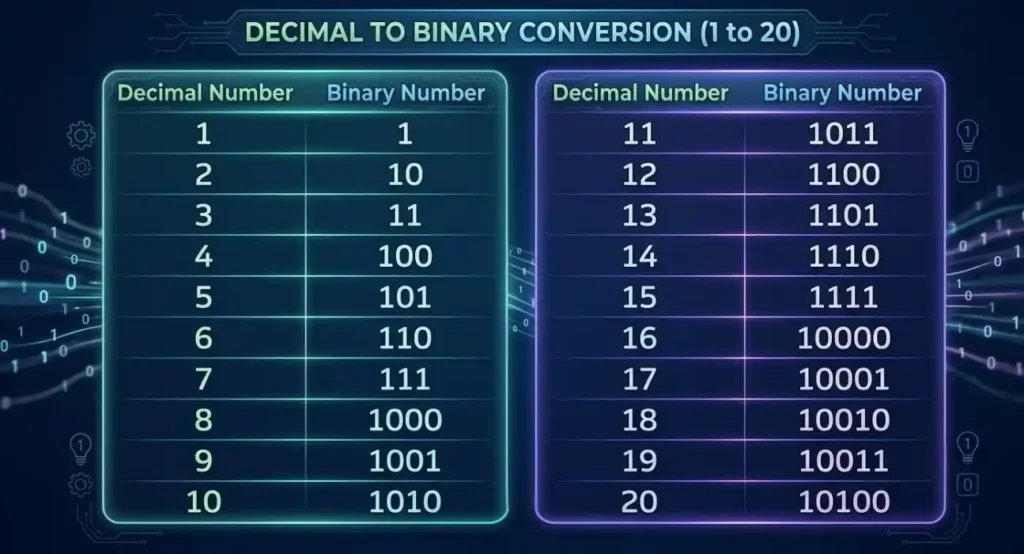
Decimal To Binary Conversion Table
How to Use TankCalculator’s Binary Calculator
1. Choose your mode. Select Binary Arithmetic, Number Conversion, Bitwise and Shift, or Binary Fraction.
2. Set your options. Pick the input base, bit length, representation (unsigned or signed), and digit grouping preference.
3. Enter your values. Type in Value A and Value B for arithmetic or bitwise operations, or a single value for conversion or fraction tabs.
4. Pick your method. Choose addition, subtraction, multiplication, or division for arithmetic; or AND, OR, XOR, NOT, and the rest for bitwise work.
5. Click the “Calculate Button”. This will provide you with an immediate answer after you click it.
You can also Export, Print, Copy your result to the clipboard or use Reset button to reset the calculator fields.
About TankCalculator’s Binary Calculator
While our binary calculator was Created to perform many more tasks than a regular binary to decimal calculator. It consists of four different tabs, each dealing with a particular kind of calculation involving number systems – Binary Arithmetic, Number Conversion, Bitwise and Shift Operations, and Binary Fractions conversion.
In the arithmetic tab, you can add, subtract, multiply, or divide numbers entered in binary, decimal, hexadecimal, or octal, with support for both unsigned and signed (two’s complement) representations across 8, 16, 32, or 64-bit lengths.
In the case of the conversion tab, you can enter any value, and it will be presented in all four number systems simultaneously, with an option to add additional bits or group digits in binary numbers.
The bitwise tab covers logical operations like AND, OR, XOR, NOT, NAND, NOR, and XNOR, plus left and right bit shifting and the fraction tab converts binary fractions to decimal and back again, showing the full working behind each conversion. On top of all that, the calculator keeps a history of recent calculations and lets you copy, print, or export your results as needed.
Key Features of TankCalculator’s Binary Calculator
Four dedicated modes: Binary Arithmetic, Number Conversion, Bitwise and Shift, and Binary Fraction, all in a single tool.
Multiple number base support: Works with binary, decimal, hexadecimal, and octal input across most calculation modes.
Signed and unsigned representation: Choose between unsigned values or two’s complement signed representation, with 8, 16, 32, or 64-bit lengths.
Full bitwise logic support: Covers AND, OR, XOR, NOT, NAND, NOR, XNOR, and both left and right bit shifting.
Step-by-step calculation traces: Shows the actual working behind addition, subtraction, multiplication, division, and fraction conversions, not just the final answer.
Bit counting: Displays the total bit length along with the count of ones and zeros in any result.
Digit grouping and padding: Optional grouping by 4 digits and bit padding make long binary strings easier to read at a glance.
Calculation History and Export: Maintains a history of recent calculations and allows users to copy, print or export the same in a CSV file.
Benefits of Using TankCalculator’s Binary Calculator
Binary math is one of those skills that seems simple in theory but gets tedious fast once you’re working with larger numbers, signed representations, or bitwise logic — the kind of calculations that show up constantly in computer science coursework and low-level programming. Doing it by hand is doable for small examples, but it’s easy to make small mistakes with carrying, borrowing, or sign handling once the numbers grow.
For students, the utility of this calculator is not only for the purpose of checking answers but also to aid in their learning process because the trace output actually gives insight on how addition, subtraction, and multiplication are carried out bit by bit in the binary system, rather than simply giving the result at the end. This type of visualization helps make abstract concepts such as two’s complement and overflow much more concrete.
The bitwise and shifting functions will be useful to developers and computer science students, in particular, since this is one of the most common types of operations used in programming languages and design of logic circuits. It is useful to be able to easily verify any AND, XOR, or shift operation and get the bit count and overflow information at the same time.
Frequently Asked Questions (FAQ)
What is 278 in binary?
The decimal number 278 is written in binary as 100010110. This means 278 is represented using powers of 2 in base-2 form.
What is 301 in binary?
The decimal number 301 converts to 100101101 in binary. Binary uses only 0s and 1s to represent numbers.
What is 230 in binary code?
The decimal number 230 in binary is 11100110. This is the base-2 equivalent of the number 230.
What is 100 in binary?
The decimal number 100 is written in binary as 1100100. In 8-bit binary form, it can also be shown as 01100100.