
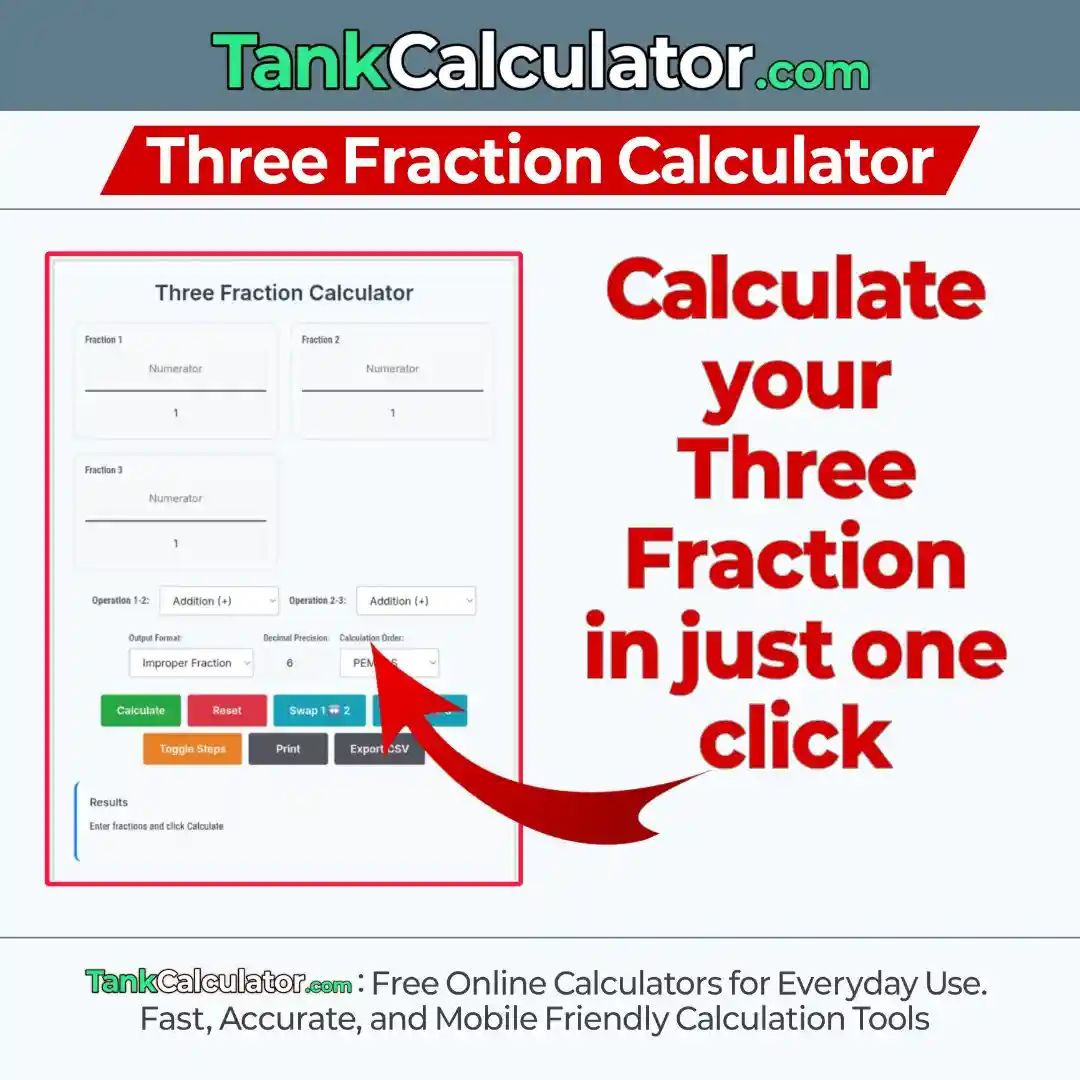
To calculate your three fractions, enter the following details given below:
Three Fraction Calculator
Results
Enter fractions and click Calculate
Step-by-Step Solution
Calculation History
Quick Navigation:
What Is a Fraction?
A fraction is a part of something. It is also a way to compare two things. In math, a fraction has two parts: the top number, which is called the numerator and the bottom number, which is called the denominator. The numerator tells you how many parts you have and the denominator tells you how many parts the whole thing is divided into.
- For example: if you have the fraction 3/4 that means you have three parts out of a total of four parts.
So when you first learn about fractions you need to understand that they can be less than one, equal to one, or more than one. You can see fractions in your daily life. They are used when you divide a pizza with your friends or when you measure things for a recipe or even when you try to figure out the chances of something happening. Fractions are really important.
Types of Fractions
Mathematics uses different types of fractions, each of which has their own special features and practical applications.
- Proper fractions have a numerator smaller than the denominator, resulting in a value less than 1.
- Improper fractions use their numerator value which equals or exceeds the denominator value to produce fractions that equal or exceed 1.
- Mixed numbers use a whole number and a proper fraction to show values that exceed 1 in a format that is easier to read.
- Equivalent fractions display different forms yet maintain identical values because their numerators and denominators were multiplied or divided by the same non-zero number.
The addition and subtraction process becomes easier with fractions because they have identical denominators.
How to Calculate Fractions: Formulas and Methods
You must understand the fundamental rules of fractions along with their mathematical formulas to complete your mathematical requirements.
Addition / Subtraction (different denominators):
The process starts with finding a common denominator which people usually establish through the LCM method and then they convert all fractions before proceeding to add or subtract the numerators.
Addition (Cross-Multiplication Shortcut):
When the denominators differ from each other, people can use cross-multiplying as a fast method for adding fractions.
Formula:
$$\frac{a}{b} + \frac{c}{d} = \frac{ad + bc}{bd}$$
You have to conduct diagonal multiplication through the operations (a×d and b×c) which you sum together to form the fraction that sits above the denominator product.
Multiplication:
The operation of multiplying fractions stands out as the simplest mathematical task.
You need to multiply the numerators which are the top numbers and then multiply the denominators which are the bottom numbers. After that, you must simplify the result if it can be reduced further.
Formula:
$$\frac{a}{b} \times \frac{c}{d} = \frac{ac}{bd}$$
Division:
Division appears complex at first sight, but it turns into an easy task after you learn the single principle which states you should flip the numbers before performing multiplication.
You need to take the reciprocal of the second fraction instead of performing division and you should multiply.
Formula:
$$\frac{a}{b} \div \frac{c}{d} = \frac{a}{b} \times \frac{d}{c}$$
Improper ⇄ Mixed Fraction Conversions
Fractions exist in two basic formats which include improper fractions and mixed number fractions.
Improper → Mixed:
The division operation requires you to divide the numerator by the denominator. The whole number results from the quotient, while the remainder becomes the new numerator.
Mixed → Improper:
The process starts when you multiply the whole number by the denominator and then you add the numerator. The result needs to be placed over the original denominator.
What Is a Three Fraction Calculator?
The three fraction calculator functions as an online math tool which performs arithmetic calculations for three fractions at the same time. The calculator processes multiple fraction operations which include addition, subtraction, multiplication and division while it automatically handles the tasks of simplification and common denominator calculation and order of operations execution.
The calculator enables users to achieve fast results in their multi-fraction math work which they require for three different tasks which are for checking homework assignments, verifying complex recipes and investigating mathematical patterns that involve three terms.
About TankCalculator’s Three Fraction Calculator
The Three Fraction Calculator provides users with a straightforward interface which enables them to process three fractions simultaneously. Our calculator delivers complete arithmetic functionality while teaching users through its detailed stepwise explanations and various result presentation methods.
Key Features of The Three Fraction Calculator
- Full Fraction Arithmetic: The calculator enables users to perform the four basic math operations on three fractions. The final outcome will undergo automatic simplification process.
- PEMDAS & Left-to-Right Modes: The user can select between the traditional PEMDAS calculation system and the basic left-to-right calculation method to evaluate both computation techniques.
- Automatic Simplification: GCD enables fractions to undergo reduction which results in answers being displayed through their most basic fraction form that contains a positive denominator.
- Swap Function: The user can quickly change the order of fractions through the function which enables users to switch between (1 ↔ 2 or 2 ↔ 3) orders.
- Step-by-Step Explanation Toggle: The function displays complete procedural steps which show all LCM calculations, conversion methods, cross-multiplication processes and final simplification steps.
- Multiple Output Formats: You can choose how to present results as either improper fractions or mixed numbers or decimals or percentages.
- Decimal Precision Control: The user can set the decimal accuracy between 0 and 15 decimal places according to their requirements.
- Calculation History: The system provides immediate access to all past calculations which users can retrieve without needing to type their information again.
- Print Function: The function creates a complete document which users can print to show their calculation results.
- CSV Export: Users can save their results as CSV files which they can use for record keeping or spreadsheet work or educational activities.
Benefits of Using The Three Fraction Calculator
- The calculator enables faster multi-fraction calculations by removing the need to manually find common denominators
- Automatic result simplification helps to reduce errors which occur during the calculation process.
- Students use this to solve their multi-fraction math problems
- Parents and tutors can use this calculator to quickly check students’ homework for accuracy, while students themselves can use it as a learning aid to better understand how fractions are simplified step by step.
- This calculator allows users to convert fractions into decimal and percentage forms with fast precision.
How to Use TankCalculator’s Three Fraction Calculator
- Step 1: Enter the Fractions:
The first step: requires you to input a fraction. You must fill the three empty boxes with your values (numerator and denominator).
- Step 2: Choose the Operations
Next step: choose a mathematical operation through the dropdown menu which contains the symbols (+, −, ×, ÷) to apply on the fraction.
- Step 3: Select Calculation Method
You must select a method to solve the equation. You can choose standard order calculations through PEMDAS or you can choose to calculate from left to right in a series of calculations.
- Step 4: Choose Output Format
The answer selection process requires you to choose between improper fraction, mixed number, decimal and percentage formats.
- Step 5: Click the “Calculate Button”
This will provide you with an immediate answer after you click it.
Frequently Asked Questions (FAQ)
Which fraction is the largest?
The largest fraction is the one with the greatest value. You can compare two fractions by transforming them into decimal numbers or by applying the method of common denominators. The fraction with the higher numerator (after conversion) is larger.
Which is greater, 1/2 or 1/4?
1/2 is greater than 1/4 because half is larger than one quarter. 1/2 equals 0.5 in decimal form while 1/4 equals 0.25.
Which is bigger, 1/2 or 1/3?
1/2 is bigger than 1/3. When converted to decimals, 1/2 equals 0.5 and 1/3 equals approximately 0.33.
How to calculate 3 mixed fractions?
First, convert each mixed number into an improper fraction. After that, you must execute the required operation which can be addition or subtraction or multiplication or division. The result requires simplification before converting it into a mixed number if necessary.
How to solve three fraction ratio?
To solve a ratio involving three fractions, first simplify each fraction if possible. The next step involves transforming the fractions into a standard format which can be either decimal form or common denominator for comparison or ratio calculation.
Is the butterfly method accurate?
Yes, The butterfly method (cross-multiplication) shows accurate results when you want to add or compare fractions that have different denominators. The method serves best as a shortcut when users need to perform calculations but they must use it with caution to avoid making errors.