
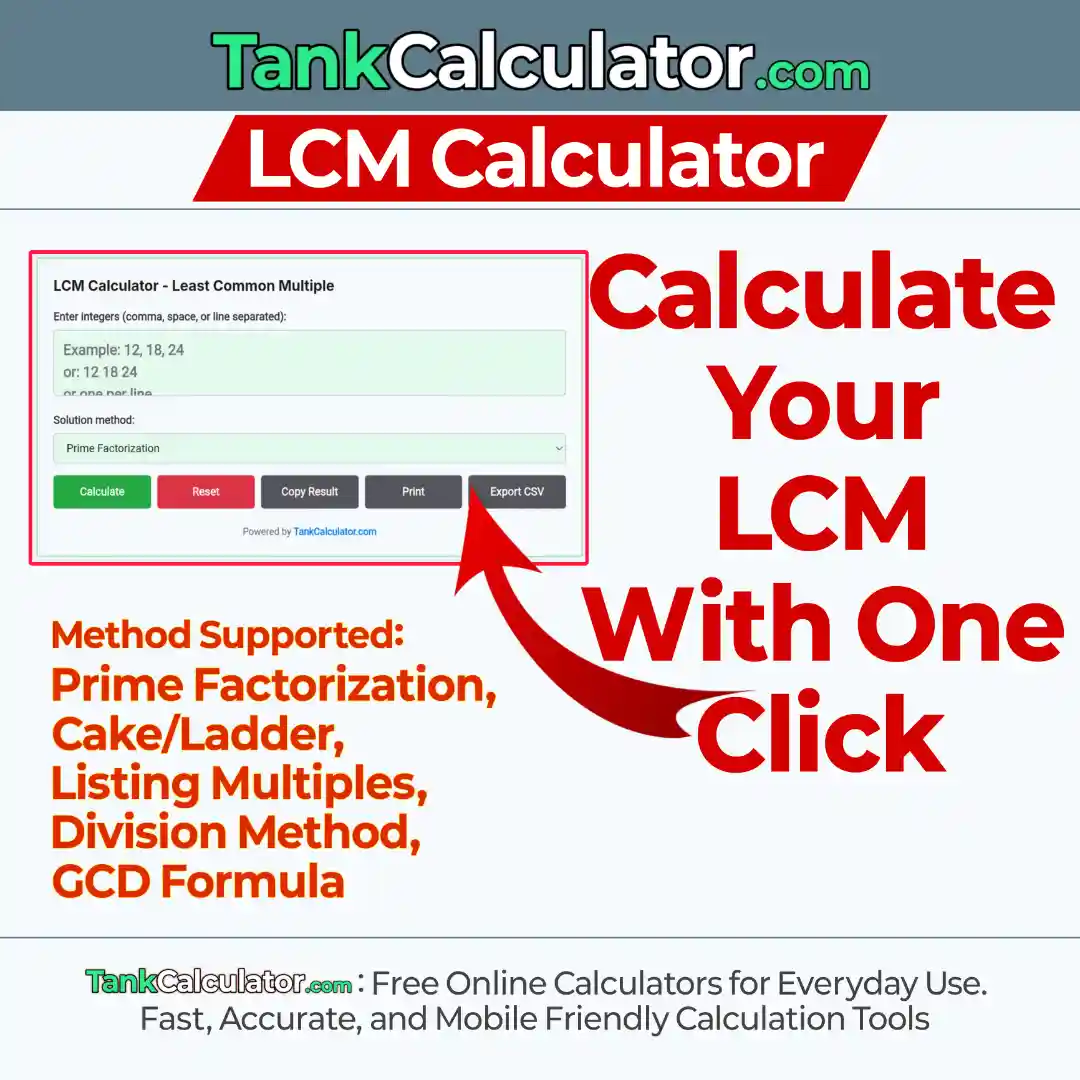
To calculate your LCM, enter the following details given below:
LCM Calculator - Least Common Multiple
Quick Navigation:
What Is LCM (Least Common Multiple)?
If you’ve ever wondered how to add two fractions with different denominators, you’ve already have been into a situation where knowing the LCM would have helped.
In simple terms, the LCM of two or more numbers is the smallest number that all of them divide into evenly. It’s the lowest value where all the given numbers “meet up” as factors.
Take 4 and 6 as an Example: Multiples of 4 are 4, 8, 12, 16, 20… and multiples of 6 are 6, 12, 18, 24… The first number that appears in both lists is 12. So the LCM of 4 and 6 = 12.
LCM vs. HCF: What’s the Difference?
People often get confused between LCM and HCF (Highest Common Factor), which is also known as GCD (Greatest Common Divisor). Both are related to eachother, but both solve different problems.
| LCM (Least Common Multiple) | HCF (Highest Common Factor) |
|---|---|
| Smallest shared multiple of two or more numbers | Largest factor that divides two or more numbers exactly |
| Exp: LCM(4, 6) = 12 | Exp: HCF(4, 6) = 2 |
| It is used to add or subtract the fractions | it is often used for simplifying fractions |
| Result is always ≥ the larger number | Result is always ≤ the smaller number |
| LCM × HCF = Product of the two numbers | HCF × LCM = Product of the two numbers |
HCF tells you how much you can simplify, while while LCM tells you the earliest common ground.
LCM Formula and the Prime Factorization Methods
There are a few ways to find the LCM of two or more numbers. The method you choose often depends on how large the numbers are and what you’re comfortable with.
1. LCM Using HCF
LCM(a, b) = (a × b) ÷ HCF(a, b)
This works because of the relationship between LCM and HCF that we saw in the comparison
Example of LCM Using HCF:
Find the LCM of 12 and 18,
Step 1: Find the HCF of 12 and 18.
- a = Factors of 12: 1, 2, 3, 4, 6, 7, 8, 9, 10, 11, 12
- b = Factors of 18: 1, 2, 3, 6, 9, 10, 11, 12, 13, 14, 15, 16 ,17, 18
- Common factors: 1, 2, 3, 6
- HCF(12, 18) = 6
Step 2: Apply the formula.
- LCM(12, 18) = (12 × 18) ÷ 6 = 216 ÷ 6 = 36
2. Prime Factorization Method for LCM
This method works well for any size of numbers and is particularly useful when dealing with more than two numbers at once. The idea is to break each number down into its prime factors, then build the LCM from those factors.
Here’s how it works:
- Find the prime factorization of each number.
- List all the prime factors that appear in any of the numbers.
- For each prime factor, take the highest power it appears with across all numbers.
- Multiply all those highest powers together — the result is the LCM.
Example of Prime Factorization Method.
Find the LCM of 12, 15, and 20,
Step 1: Prime factorizations.
- 12 = 2² × 3
- 15 = 3 × 5
- 20 = 2² × 5
Step 2: Identify all prime factors: 2, 3, and 5.
Step 3: Take the highest power of each.
- Highest power of 2: 2² = 4
- Highest power of 3: 3¹ = 3
- Highest power of 5: 5¹ = 5
Step 4: Multiply them together.
- LCM(12, 15, 20) = 4 × 3 × 5 = 60
3. LCM of Fractions
This method is bit different from working with whole numbers, but the logic is consistent.
LCM of Fractions = LCM of Numerators ÷ HCF of Denominators
This might look odd at first — why divide by the HCF of denominators? The reasoning is tied to how fractions represent parts of a whole.
To find the smallest fraction that all the given fractions can divide into, to maximize the top (numerators) and minimize the bottom (denominators).
Example of LCM of Fractions
Find the LCM of 2/3 and 4/9,
Step 1: Find LCM of the numerators (2 and 4).
- Multiples of 2: 2, 4, 6, 8…
- Multiples of 4: 4, 8, 12…
- LCM(2, 4) = 4
Step 2: Find HCF of the denominators (3 and 9).
- Factors of 3: 1, 3
- Factors of 9: 1, 3, 9
- HCF(3, 9) = 3
Step 3: Apply the formula.
- LCM(2/3, 4/9) = 4 ÷ 3 = 4/3
What Is an LCM Calculator?
An LCM calculator is an online calculator app that computes the Least Common Multiple of two or more numbers instantly — without the need for manual calculations.
Instead of going through factorization steps by hand (which can get tedious for larger numbers), you simply enter the values and the calculator does all the work in the background for you and gives you solution.
How to Use the TankCalculator’s LCM Calculator
Step 1 — Enter Your Numbers: Enter integers (comma, space, or line separated)”
Step 2 — Select Calculation Method: Prime Factorization, Cake/Ladder, Listing Multiples, Division Method, and GCD Formula
Step 3 — Click the “Calculate Button”: This will provide you with an immediate answer after you click it.
Click the “+ Show Step-by-Step Solution” toggle button to expand a detailed summary of the calculation. This will breaks down each stage of the selected method.
LCM Reference Table (Answer Key)
| Query | Answer |
|---|---|
| LCM of 6 and 9 | 18 |
| LCM of 8 and 12 | 24 |
| LCM of 4 and 6 | 12 |
| LCM of 6 and 8 | 24 |
| LCM of 6 and 10 | 30 |
| LCM of 9 and 12 | 36 |
| LCM of 8 and 10 | 40 |
| LCM of 4 and 10 | 20 |
| LCM of 12 and 8 | 24 |
| LCM of 10 and 12 | 60 |
| LCM of 12 and 15 | 60 |
| LCM of 12 and 18 | 36 |
| LCM of 3 and 4 | 12 |
| LCM of 3 and 9 | 9 |
| LCM of 4 and 9 | 36 |
| LCM of 5 and 8 | 40 |
| LCM of 7 and 8 | 56 |
| LCM of 7 and 9 | 63 |
| LCM of 8 and 9 | 72 |
| LCM of 10 and 5 | 10 |
| LCM of 12 and 16 | 48 |
| LCM of 2 and 3 | 6 |
| LCM of 2 and 5 | 10 |
| LCM of 4 and 8 | 8 |
| LCM of 5 and 10 | 10 |
| LCM of 5 and 7 | 35 |
| LCM of 9 and 6 | 18 |
| LCM of 6 and 12 | 12 |
| LCM of 10 and 6 | 30 |
| LCM of 3 and 7 | 21 |
| LCM of 12a²b and 42ab³ | 84a²b³ |
About the TankCalculator’s LCM Calculator
Our LCM Calculator goes beyond simply returning a result. It supports five distinct solution methods — Prime Factorization, Cake/Ladder Method, Listing Multiples, Division Method, and GCD Formula — giving user the flexibility to choose the method that best suits user’s context or learning need.
What TankCalculator’s LCM Calculator Computes
For any set of valid positive integers entered by the user, the calculator will:
- Computes the LCM (least common multiple/lowest common denominator).
- Computes the GCD/HCF (greatest common divisor/highest common factor).
- Display the product of all entered values.
- Find the total number of prime factors in the entered values.
- Show the methodology used for solving the problem (factorization method/step-by-step solution formula).
- Offer an expandable solution panel.
- Keep a record of calculation history.
Methods in TankCalculator’s LCM Calculator
| Method | Best Used When |
|---|---|
| Prime Factorization | Learning the standard method; works for all input sizes |
| Cake / LCM Calculator Ladder Method | Teaching visually using a table; good for classroom use |
| Listing Multiples | Understanding LCM intuitively; suitable for small numbers (up to 6 inputs) |
| Division Method | Similar to Cake method but using successive division for any number of inputs |
| GCD Formula | Preferred for pairs of numbers; leverages the LCM-GCD relationship |
Key Features of the TankCalculator’s LCM Calculator
Multi-number Input: Accepts more than two integers in comma, space, or in a newline format — without limit on the count of numbers.
Five Solution Methods: Prime Factorization, Cake/Ladder, Listing Multiples, Division Method, and GCD Formula — selectable from a dropdown.
Step-by-Step Solution: Expandable panel showing the full solution in numbered steps for the selected method.
Visual Method Display: Tables and formatted outputs for Cake or Division methods; factorization chains for Prime method; multiple listings for Multiples method.
Summary Statistics Grid: Displays LCM, GCD/HCF, product of inputs, distinct prime count, total input count, and estimated step count.
Auto Method Switching: Changing the solution method from dropdown re-runs the calculation instantly without clicking Calculate again.
Duplicate Detection: Detects and notes duplicate numbers in the input while still computing the correct result.
Input Validation: Catches non-integers, zeroes, negative values, empty inputs, and oversized numbers with clear error messages.
Calculation History: Stores up to 10 recent calculations in; it also supports Reload and Delete per entry.
Copy, Export, and Print Results: Once the LCM has been calculated, you will be able to copy the output to your clipboard in a single click in the form LCM(a, b, …) = X, download the entire calculation data in the form of a structured CSV file that can be used in Excel, or even print the calculations via your web browser.
Benefits of Using the TankCalculator’s LCM Calculator
To the student, it provides instant verification of the solution to their homework problems, multiple solutions to a problem at once, detailed step-by-step solutions. To the teacher, it provides instant solution of Cake/Ladder table and division table for classroom demonstration and teaching, and allows printing/exporting like CSV for handouts. To the professional, it allows calculations of gear ratios, time intervals, and recurring events, supports large numbers using BigInt.
Frequently Asked Questions (FAQ)
What is the least common denominator of 3⁄4, 4⁄5, and 2⁄3?
The least common denominator (LCD) of 3⁄4, 4⁄5, and 2⁄3 is 60.
Here’s how it works: the LCD is just the smallest number that 4, 5, and 3 can all divide into evenly. To find it, you look at the LCM of the denominators — 4, 5, and 3.
Start with 4 and 5. Their LCM is 20. Now take 20 and find its LCM with 3. Since 20 isn’t divisible by 3, you go to 60 — and yes, 60 ÷ 4 = 15, 60 ÷ 5 = 12, and 60 ÷ 3 = 20. All clean divisions.
So when you’re adding or comparing these fractions, convert them all to have 60 as the denominator: 3⁄4 becomes 45⁄60, 4⁄5 becomes 48⁄60, and 2⁄3 becomes 40⁄60.
What is the LCM of 1, 2, 3, 4, 5, 6, 7, 8, 9, 10?
The LCM of all numbers from 1 to 10 is 2520.
To find it, you don’t need to test every combination. Instead, look at the highest prime powers within the range: 2³ (which is 8), 3² (which is 9), 5¹, and 7¹. Multiply those together:
8 × 9 × 5 × 7 = 2520
What are the factors of 1, 2, 3, 4, 5, 6, 7, 8, 9, and 10?
Factors are just the numbers that divide evenly into a given number. Here’s a quick breakdown:
1 → 1
2 → 1, 2
3 → 1, 3
4 → 1, 2, 4
5 → 1, 5
6 → 1, 2, 3, 6
7 → 1, 7
8 → 1, 2, 4, 8
9 → 1, 3, 9
10 → 1, 2, 5, 10
What number has 100,000,000,000,000,000,000,000,000,000 zeros?
That’s 10 to the power of 10³⁰ — or written out, a 1 followed by a nonillion zeros, which itself is a staggeringly large number.
But let’s step back and make sense of it. When we talk about numbers defined by how many zeros they have, we’re really talking about powers of 10. A number with 100 zeros after a 1 is called a Googol (10¹⁰⁰). A number with a googol of zeros is called a Googolple (10^Googol).