
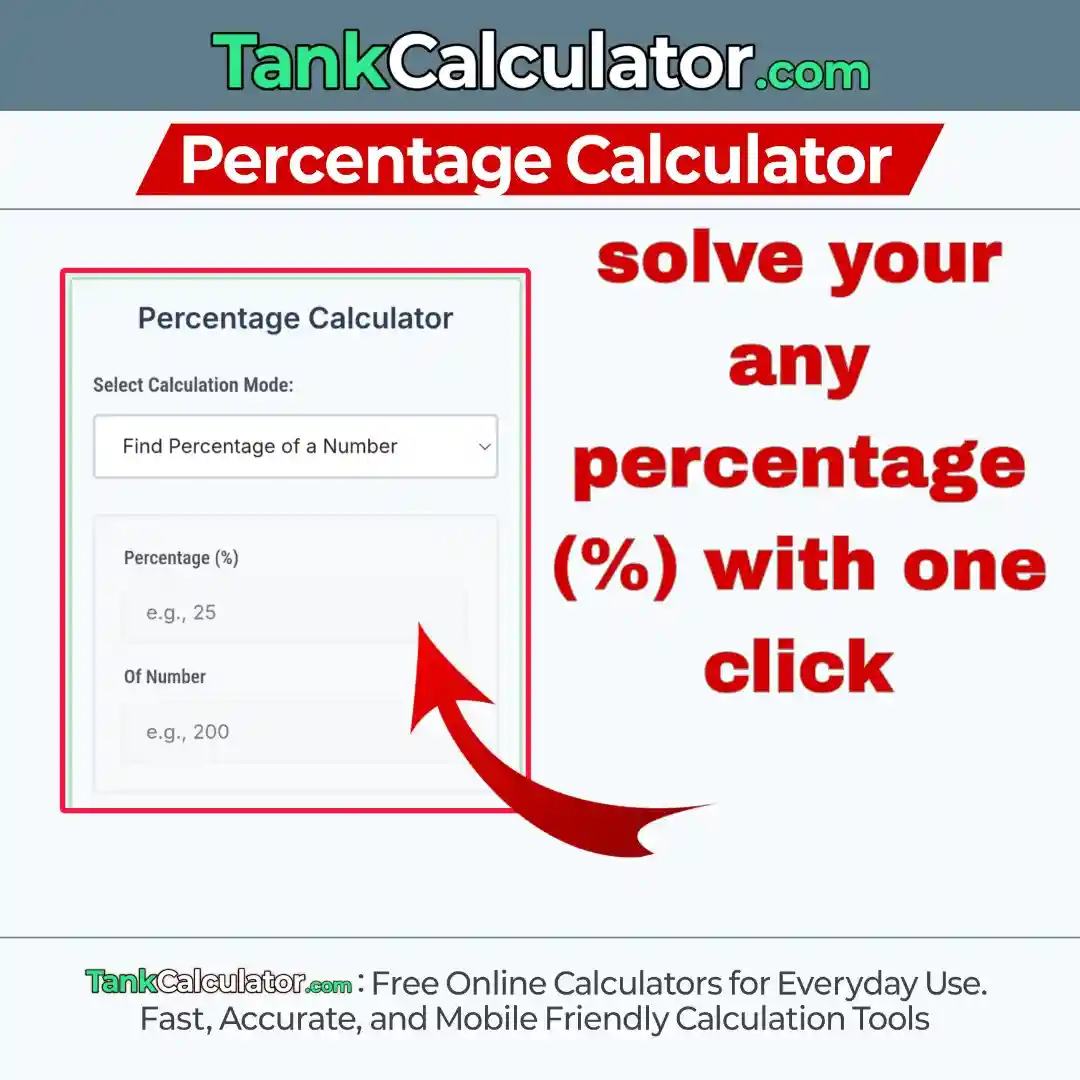
To calculate your Percentage, enter the following details given below:
Percentage Calculator
Results
Select a mode and enter values to calculate
Step-by-Step Solution
Calculation History
Quick Navigation:
What Is a Percentage?
If you’ve ever seen a “30% off” sign at a store or checked your test score as a grade, you’ve already worked with percentages you just might not have thought about what the word actually means.
A percentage is a way of expressing a number as a fraction of 100. The word itself comes from the Latin per centum, which literally means “per hundred.” So when someone says 45%, they mean 45 out of every 100.
Percentage Definition in Math
In mathematics, a percentage is a dimensionless ratio a way of comparing a part to a whole using 100 as the base. It’s written using the “%” symbol.
For example, if 20 out of 100 students passed a test, that’s a 20% pass rate. But percentages aren’t limited to situations where the total is 100.
The standardized method of value comparison across different measurement systems enables users to conduct their evaluations in a standardized manner. Which score was better between your 18 out of 25 score and your 42 out of 60 score on the two quizzes? The raw numbers make it difficult to determine which score is superior. The comparison between 72% and 70% becomes clear after both values have been converted to percentages.
Percentage in Mathematics Explained for Beginners
For new students and kids who want to understand this in an easy way, So’s the straightforward way to understand what percentages mean in math:
- 100% means the whole thing all of it.
- 50% means half.
- 25% means a quarter.
- 1% means one tiny part out of a hundred equal parts.
Percentages sit alongside fractions and decimals as three different ways of expressing the same idea. For instance, 75% is the same as 3/4 (a fraction) and 0.75 (a decimal). They’re interchangeable percentages are just often easier to communicate and compare.
How to Calculate Percentage?
Getting Knowledge about the formulas is what lets you move from understanding to actually solving problems confidently. Below are the essential percentage formulas in math.
Basic Percentage Formula
P% of X = (P ÷ 100) × X
Use this when you know the percentage and want to find the actual value.
Example: 15% of 200 = (15 ÷ 100) × 200 = 30
Percentage Formula: X Is What Percent of Y?
Percentage = (X ÷ Y) × 100
Use this when you want to express a part as a percentage of the whole.
Example: 45 is what percent of 180? → (45 ÷ 180) × 100 = 25%
Percentage Change Formula
% Change = ((New − Old) ÷ Old) × 100
Use this to measure increases or decreases.
Example: A salary goes from $3,000 to 3,600. → ((3600 − 3000) ÷ 3000) × 100 = 20% increase
Reverse Percentage Formula (Finding the Original Value)
Original = Value ÷ (1 ± Percentage/100)
Use this when you know a value after a percentage change and need to work backward.
Example: A price after a 25% increase is $125. Original price = 125 ÷ 1.25 = $100
Percentage Difference Formula
% Difference = (|A − B| ÷ ((A + B) ÷ 2)) × 100
Use this when comparing two values and neither one is clearly the “original.”
Other Percentage Formulas
The most common percentage question is: what percentage of a whole does a specific part represent? Here’s how to work that out:
- Identify the part and the whole.
- Divide the part by the whole.
- Multiply the result by 100.
So the formula looks like this:
- Percentage = (Part ÷ Whole) × 100
Let’s say you answered 38 questions correctly out of 50 on a test. Divide 38 by 50, which gives you 0.76. Multiply by 100 and you get 76%. That’s your score.
How to Calculate Percentage of a Number
Another common task is finding a percentage of a given number. For example, what is 20% of 250?
- Convert the percentage to a decimal divide by 100. So 20% becomes 0.20.
- Multiply by the number. 0.20 × 250 = 50.
So 20% of 250 is 50. This method works for any percentage and any number.
How to Calculate Percentage Increase or Decrease
Percentage change shows how much a value has gone up or down relative to where it started. The formula is:
- Percentage Change = ((New Value − Old Value) ÷ Old Value) × 100
If a result is positive, the value increased. If it’s negative, it decreased.
Example: A product that cost $80 now costs 100. The increase is $20. Divide 20 by 80 (the original), and multiply by 100 that’s a 25% increase.
How to Find What Percentage One Number Is of Another
This is a variation beginners sometimes find confusing. If someone asks, “18 is what percent of 72?” use the same core idea:
- (18 ÷ 72) × 100 = 25%
The key is always dividing the part by the reference value and then scaling by 100.
What Is a Percentage Calculator?
Any calculation of percentages requires you to know the correct formula which enables you to do basic math operations and understand the resulting data. The procedure operates correctly when applied to a single basic computation.
Percentage Calculator Modes
Our percentage calculator solves all types of percentage problems that people encounter in their daily lives. It works through several key modes, which I will explain in detail along with their main functions.
Find Percentage of a Number
- What it does: Calculates X% of a given number.
Example: What is 30% of 450? equals 135
What Percent Is A of B?
- What it does: Finds what percentage A represents relative to B.
Example: 90 is what percent of 360? equals 25%
Percentage Increase
- What it does: Calculates how much a value increased as a percentage.
Example: Price went from $50 to 65 equals 30% increase
Percentage Decrease
- What it does: Measures how much a value dropped as a percentage.
Example: From 200 to 150 equals 25% decrease
Reverse Percentage (Find Original Value After Increase or Decrease)
- What it does: Works backward from a final value to find what the original was before a percentage change.
Example: After a 20% increase, the value is $240. Original = $200
Discount & Sale Price Calculator
- What it does: Calculates the sale price after applying a discount percentage, and the amount saved.
Example: $120 item with 35% off equals You pay 78, saving $42
Percentage Difference
- What it does: Compares two values symmetrically neither is treated as the “original.”
Example: Comparing 80 and 100 equals Percentage difference = 22.2%
Compound Percentage Growth (Multiple Periods)
- What it does: Calculates growth over multiple periods with compounding.
Example: $1,000 growing at 8% per year for 5 years equals $1,469.33
How to Use TankCalculator’s Percentage Calculator
1. Select the calculation mode from the dropdown list.
2. Enter the percentage numbers in the boxes that appear.
3. Choose your desired decimal precision the default is 2 decimal places, you can adjust this from 0 to 10.
4. Click Calculate button This will provide you with an immediate answer after you click it.
5. (Optional) Check “Show Steps” if you want to see the full working every formula.
- Use Swap Values, Print, Export CSV, or check the History panel as needed. Click Reset to reset all parameters.
About TankCalculator’s Percentage Calculator
Our Percentage Calculator functions as an advanced online tool which enables users to complete all percentage calculations with quickness and precision and simple comprehension. The calculator provides complete percentage calculation capabilities which include basic “what is X% of Y?” questions and advanced reverse percentage calculations and compound growth modeling and percentage difference analysis.
Key Features of the Percentage Calculator
The advanced percentage calculator which includes multiple features functions better than the standard percentage calculator which provides basic features.
Smart Input Fields: The system adjusts input fields automatically according to the chosen mode which results in a streamlined interface that avoids showing irrelevant fields for your particular case.
Step by Step Solutions: The user can display all calculation steps through toggleable detailed workings which present every formula step and substitution process.
Flexible Precision Control: The user can select decimal precision from 0 to 10 for their chosen range.
Swap Values Button: The mode allows instant value exchange between A and B which enables users to conduct their comparison tests through direct value exchange without needing to retype their data.
Calculation History: The tool displays your last 5 calculations which allows you to view previous results without entering numbers again.
Print and Export Ready: The one click print function creates a tidy output of your results while the CSV export enables seamless integration of your calculations into spreadsheets and reports.
Benefits of Using the Percentage Calculator
The dedicated percentage calculator delivers practical user benefits which extend beyond its present features. The system reduces time spent on repetitive percentage calculations when users need to handle multiple calculations or compare different values. The system works by automatically picking the correct formula which helps users find errors through its verification process.
Students learn percentage concepts through complete understanding because they see all calculation steps instead of only receiving results. The application assists users with practical activities which include shopping discounts and salary raises and investment growth and price comparisons and statistical analysis. The program requires no installation or registration because it functions immediately on all devices which access any browser.
Frequently Asked Questions (FAQ)
What is 40% of 100 marks?
40% of 100 equals 40 marks.
Theory: A percentage means per/100.
Formula: (Percentage ÷ 100) × Total→ (40 ÷ 100) × 100 = 40
How much is 75% out of 40?
75% of 40 equals 30.
Theory: Convert the percentage into a decimal (75% = 0.75).→ 0.75 × 40 = 30
How much is 70% from 45?
70% of 45 equals 31.5
Theory: Multiply the total value by the percentage.
(70 ÷ 100) × 45 = 31.5
How do I calculate 30% of 80?
30% of 80 equals 24
Theory: You can use two simple methods:
Decimal method: 0.30 × 80 = 24
Fraction method: (30 ÷ 100) × 80 = 24
What is the net discount for successive discounts of 30% and 40%?
30% and 40%?
Suppose The total discount is 58%.
Theory: Successive discounts are not added directly.
Formula:
Total Discount = A + B − (A × B ÷ 100)
30 + 40 − (30 × 40 ÷ 100) = 58%