
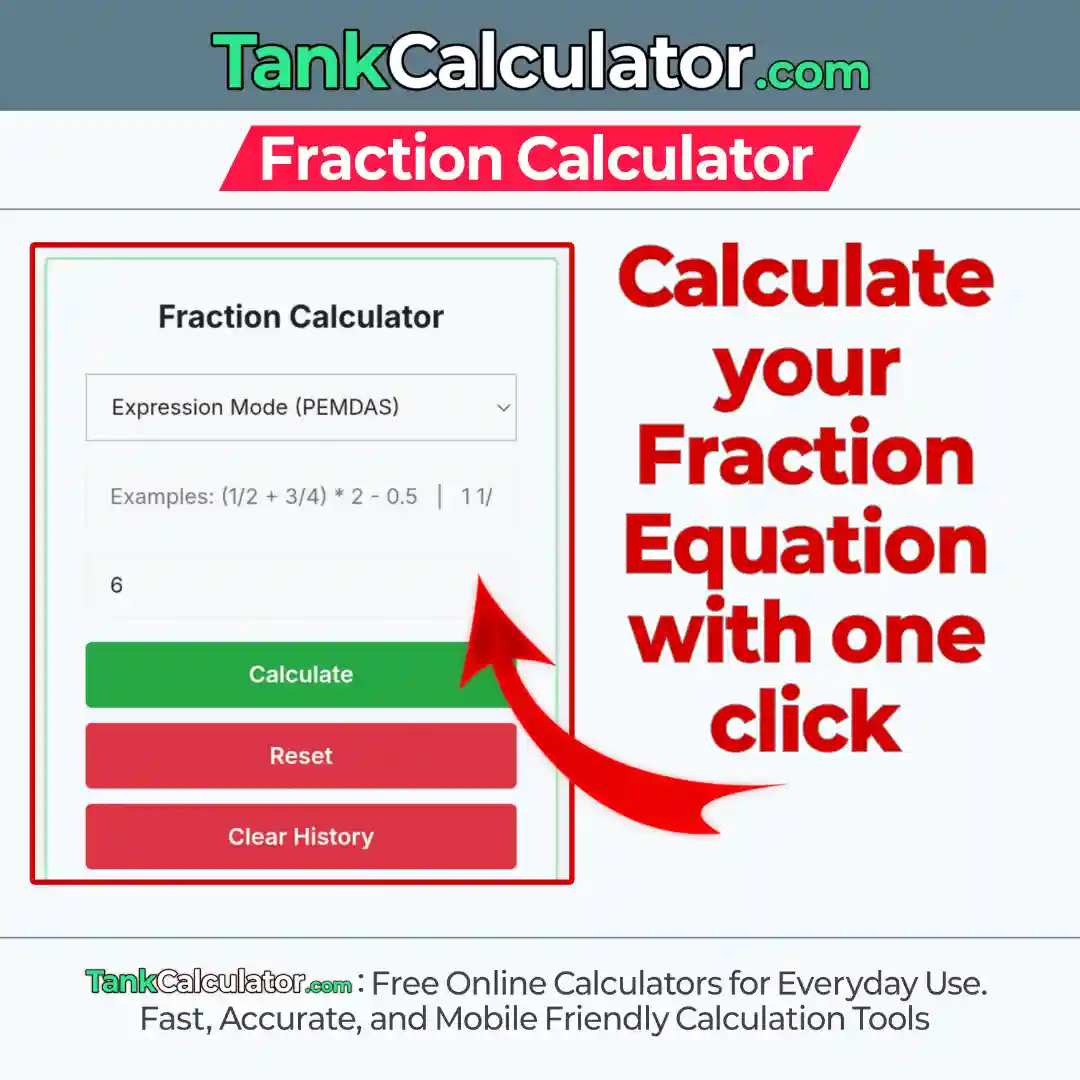
To calculate your equation, enter the following details given below:
Quick Navigation:
About Tankcalculator’s Fraction Calculator
Our Fraction Calculator stands out as a versatile and reliable calculator that goes well beyond simple arithmetic. The tool provides exceptional fraction and decimal and mixed number and complex expression and basic equation handling which benefits students and teachers and engineers and anyone who works with fractional measurements.
Useful Multi-Mode Functionality
The calculator features a total of five separate modes which enable it to handle various mathematical operations.
Expression Mode (PEMDAS):
(PEMDAS) stands for:
- P – Parentheses
- E – Exponents
- M – Multiplication
- D – Division
- A – Addition
- S – Subtraction
You can type full mathematical expressions into this mode which allows the calculator to execute the operations according to the established order of operations rules that involve Parentheses and Exponents and left to right Multiplication and Division and left to right Addition and Subtraction. It works with parentheses, basic operations (+, −, ×, ÷), fractions, mixed numbers, decimals, and whole numbers. The results display simplified forms which allow users to choose between fractions and decimals and percentages for their convenience.
Simplify Fraction Mode
Need to reduce a fraction to its lowest terms? The calculator uses a streamlined GCD method to reduce your input automatically without requiring users to conduct any manual testing of possible solutions. Enter something like 12/18, and you’ll get 2/3 right away.
Fraction to Decimal Converter
Convert any fraction or mixed number into a decimal value with control over precision. The capacity to modify decimal points up to 12 gives significant advantages for projects which require precise measurements especially in engineering and scientific applications.
Compare Fractions Mode
The tool enables users to determine which of two fractions is larger or smaller or equivalent in value.
Linear Equation Solver
The program can solve basic linear equations which follow the ax + b = c structure.
Features:
- History: Your current calculations become accessible for review through the built-in calculation history feature.
- Export: You can print results with one click or export them as CSV files for records, reports, or further analysis.
- Adjustable Decimal: The calculator enables users to select their desired decimal output format based on their individual requirements.
How to Use Tankcalculator’s Fraction Calculator?
- Step 1: Choose Your Mode
- Select mode through the dropdown menu located at the top of the screen.
- Expression Mode (PEMDAS)
- Simplify Fraction
- Fraction ← Decimal
- Compare Fractions
- Solve Equation (ax+b=c)
- Select mode through the dropdown menu located at the top of the screen.
- Step 2: Enter Your Problem
- Type your Equation directly into the field. The calculator recognizes various formats, such as:
- Expressions: (1/2 + 3/4) * 2
- Mixed numbers: 1 1/2 + 2 3/4
- Simple fractions: 8/12 or 3/4
- Comparisons: 1/2, 3/4
- Equations: 5x + 2 = 12
- The calculator can intelligently recognize and process mixed numbers and decimals together with additional types of data.
- Type your Equation directly into the field. The calculator recognizes various formats, such as:
- Step 3: Set Decimal Precision (Optional)
- Want 2 decimal places?
- Want 8 decimal places?
- The precision field lets you change the decimal output according to your preferences.
- Step 4: Hit “Calculate”
- The output results appear on the screen without delay.
What are Fractions?
Fractions represent parts of a whole or ratios between quantities. A fraction displays how many equal parts you possess out of the complete set of parts. For example, if you divide a pizza into 8 slices and eat 3, you have consumed 3/8 of the pizza.
Types of Fractions
Fractions exist in multiple categories which mathematicians use for specific mathematical applications.
Proper Fractions:
These fractions have numerators that are smaller than their denominators which results in values that always remain below 1. The values 3/4 and 2/5 and 7/10 serve as examples of fractions which describe portions that are less than an entire unit.
Improper Fractions:
The value of improper fractions starts from 1 when the numerator reaches the level of the denominator. Examples include 5/3 and 9/2 and 11/4. These typically occur when combining complete units together with their fractional components.
Mixed Numbers:
A mixed number combines a whole number and a proper fraction, such as 2 1/3 or 5 3/4. They provide a straightforward method to show amounts that exceed one while maintaining the visibility of the fractional portion.
Equivalent Fractions:
These fractions look different but they represent exactly the same value as 1/2 and 2/4 and 3/6. The process of multiplying both the numerator and the denominator by an identical number produces equivalent fractions which facilitate the comparison and combination of fractions.
Like and Unlike Fractions:
Like fractions enable easy addition and subtraction operations because they possess identical denominators (e.g., 2/7 and 5/7). Unlike fractions require the establishment of a shared denominator before their operations can proceed because they possess different denominators (e.g., 1/4 and 2/3).
How to Calculate Fractions: Formula & Method
The mathematical process of handling fractions follows established rules. The predictable behavior of fraction problems emerges when you comprehend the operational formulas for each fraction operation. The following document contains essential fraction formulas along with real world applications to support your correct implementation of these formulas.
1. Adding Fractions
The process becomes simple when both fractions have identical denominators. You don’t touch the bottom number you simply add the numerators.
For example:
- 3/8 plus 2/8 equals
The addition of both fractions requires you to add their numerators because both fractions share the same eighths division.
- 3 plus 2 equals 5
The answer shows up as: 5/8
You remain in eighths because your work continues with eighths yet you merge different portions of identical sized segments.
But what if the denominators are different? Many students struggle at this point because they lack understanding. The concept becomes less difficult after you grasp its meaning.
For Example:
- 1/3 plus 1/4
The two fractions use different fractional divisions because they contain thirds and fourths.
- 1 times 4 results in 4
- 1 times 3 results in 3
Now add those results:
- 4 plus 3 equals 7
Next, multiply the denominators:
- 3 times 4 equals 12
So the final answer is: 7/12
You have changed both fractions into twelfths without needing to document any additional calculations.
2. Subtracting Fractions
Subtraction follows the same logic as addition.
For Example:
- 5/6 minus 1/4
First, cross multiply:
- 5 times 4 equals 20
- 1 times 6 equals 6
Now subtract:
- 20 minus 6 equals 14
Now, multiply both denominators together.
- 6 times 4 equals 24
So you get:
- 14/24
The work remains unfinished because the fraction needs simplification.
- Both 14 and 24 can be divided by 2:
- 14 divided by 2 equals 7
- 24 divided by 2 equals 12
Final answer is: 7/12
You should verify answer reduction possibilities because it maintains answer organization and prevents errors.
3. Multiplying Fractions
The process of multiplying fractions represents the simplest mathematical operation.
Multiply straight across top with top bottom with bottom.
For example:
- 2/3 times 5/7
Multiply the numerators:
- 2 times 5 equals 10
Now, multiply both denominators together.
- 3 times 7 equals 21
So the answer is: 10/21
4. Dividing Fractions
The division process operates differently from other mathematical operations yet students find it simple after learning the division method.
The second fraction needs to be flipped during fraction division because this equation requires you to multiply the resulting fractions instead of dividing them further.
For Example:
- 3/4 divided by 2/5
- First, flip 2/5 to 5/2.
Now multiply:
- 3/4 times 5/2
Multiply across:
- 3 times 5 equals 15
- 4 times 2 equals 8
The result shows up as: 15/8
You can find the mixed number equivalent by dividing 15 by 8.
- 15 divided by 8 results in 1 remainder 7.
So the mixed number is: 1 7/8
5. Converting an Improper Fraction to a Mixed Number
An improper fraction has a numerator larger than the denominator.
For Example:
- 17/5
The operation requires you to divide 17 by 5.
- 17 divided by 5 results in 3 remainder 2.
The whole number is 3. The remainder becomes the numerator. The denominator stays 5.
So the answer is: 3 2/5
6. Converting a Mixed Number to an Improper Fraction
The process reverses by completing three basic actions.
For Example:
- 2 3/4
First, multiply the whole number by the denominator:
- 2 times 4 equals 8
Then add the numerator:
- 8 plus 3 equals 11
Place that over the original denominator: 11/4
7. Simplifying Fractions (Using GCD)
The process of simplifying fractions involves reducing fractions until they reach their most simplified form.
For Example:
- 18/24
To simplify it, we first need the GCD of 18 and 24.
The GCD for this case study equals 6.
All numbers must be divided by 6.
- 18 divided by 6 equals 3
- 24 divided by 6 equals 4
So the simplified fraction is: 3/4
What is a Fraction Calculator?
Fraction calculators function as web based applications which execute fractional calculations through automatic processes. The tool provides instant results through its automatic fraction handling of all operations which include simplification, conversion, comparison and fraction expression solving.
Benefits of Fraction Calculator
The use of a fraction calculator enables users to complete their work faster than using pencil and paper particularly when dealing with difficult or lengthy problems. The calculator prevents errors which occur from incorrect calculations and rule omissions thus proving beneficial for students who need to learn new concepts and professionals who require fast and accurate results. The calculator provides reliable fractional mathematical support for users who need to understand basic concepts or solve complex problems.
Frequently Asked Questions (FAQ)
What is a unit fraction?
A unit fraction has a numerator of 1 and any positive integer denominator, such as 1/2, 1/3, or 1/5. It represents one equal part of a whole and serves as the basic building block for all other fractions.
What is a non unit fraction?
A non unit fraction has a numerator greater than 1, for example 2/3, 5/8, or 7/4. The fraction system presents two types of fractions which include proper fractions and improper fractions.
What are the 5 constructs of fractions?
Five main methods exist for viewing fractions which include their function as part whole (parts of a divided whole), their function as measure (on a number line or quantity), their function as division (e.g., 3/4 means 3 ÷ 4), their function as operator (scaling or multiplying a quantity), and their function as ratio (comparing two amounts proportionally).
Why are fractions so important?
Fractions exist as fundamental mathematical tools because they enable people to express non integer quantities through various mathematical applications which include portions and ratios and measurements and probabilities.