
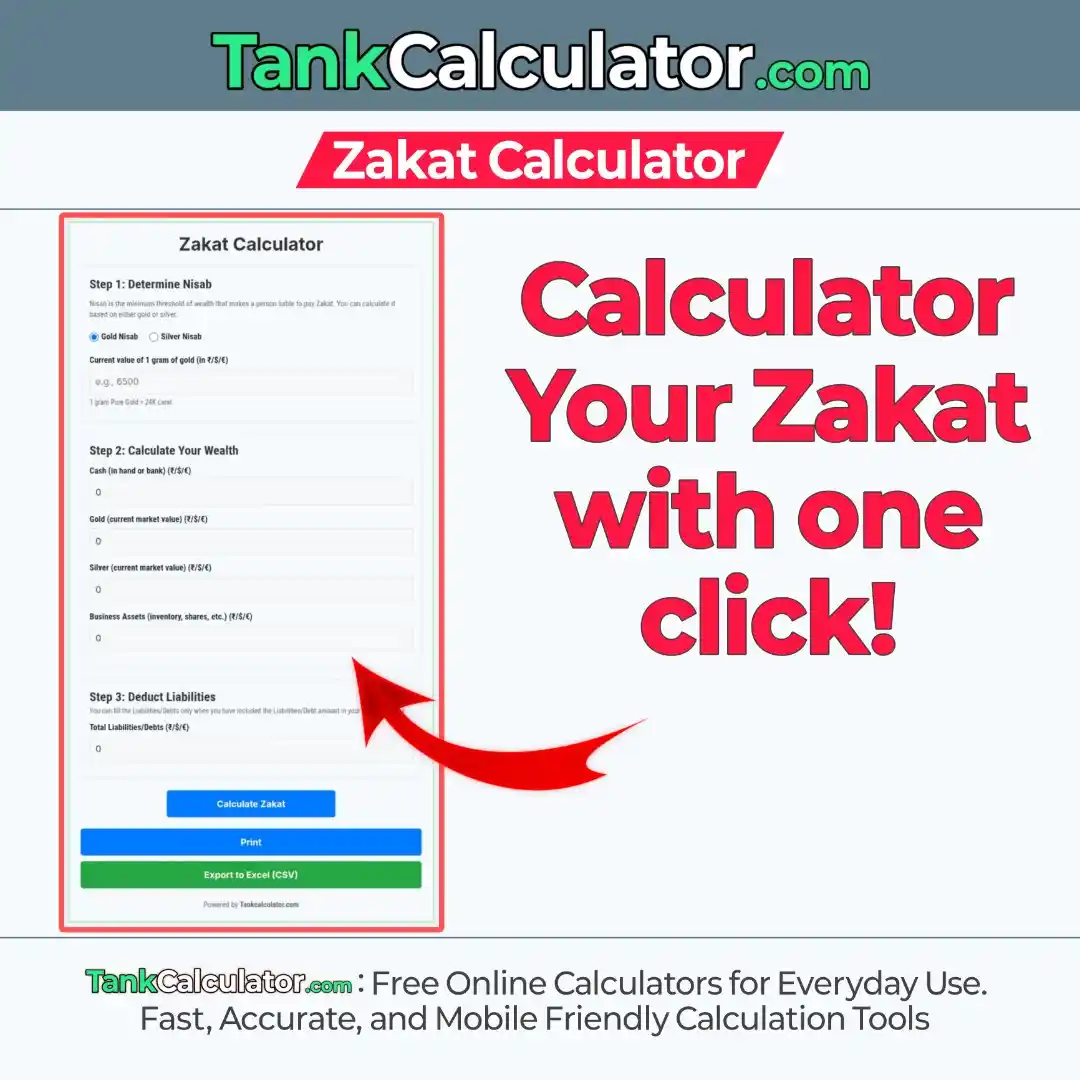
To calculate your Zakat, enter the following details given below:
Zakat Calculator by tankcalculator.com
Nisab is the minimum threshold of wealth that makes a person liable to pay Zakat. You can calculate it based on either gold or silver.
You can fill the Liabilities/Debts only when you have included the Liabilities/Debt amount in your Wealth balance
The tool calculates results through standard formulas which the user can apply. For personalized advice, especially on what counts as zakatable assets, consulting a knowledgeable imam or financial advisor familiar with Islamic principles is recommended. The process helps you determine your zakat obligations based on your specific situation.
Quick Navigation:
What Is Zakat?
Zakat stands as one of the fundamental pillars of Islam, serving as a form of obligatory charity that Muslims around the world observe. The act of giving money extends beyond its surface value because it serves as a religious practice that helps people achieve their social justice goals and their personal spiritual development. Zakat operates as a system that redistributes wealth to deliver essential support to needy people while helping the giver remember their life advantages.
Who is Eligible for Zakat?
Zakat constitutes an obligatory charity requirement established by Islam, which adult Muslims who possess wealth above the nisab threshold must fulfill.
The obligation only arises when your total zakatable assets surpass the nisab limit and you have maintained them for an entire lunar year, which Islamic law designates as hawl.
The nisab establishes the threshold for determining when zakat becomes payable. The traditional method establishes the zakat obligation based on precious metal values, which Islamic teachings have established to occur in prophetic guidance:
- Gold Nisab: Equivalent to 87.48 grams of pure gold (approximately 2.81 troy ounces).
- Silver Nisab: Equivalent to 612.36 grams of pure silver (approximately 19.69 troy ounces).
- Formula: Zakat = Zakatable Wealth × 2.5%
The silver nisab serves as the preferred standard for scholars who calculate zakat obligations based on cash and savings and other assets because it establishes a lower threshold. This method enables more individuals to meet zakat payment requirements, resulting in increased assistance to those who require it, while also achieving the goal of maximizing benefits for the impoverished. The gold nisab remains the preferred choice for some people because it provides stability throughout history and matches their specific circumstances.
Zakat becomes due when a complete lunar year passes after your wealth reaches the nisab threshold without any reduction of your assets. You may select any date for your payment after the completion of the year because there exists no specific date for payment. Many Muslims prefer to fulfill this obligation during Ramadan to combine it with the heightened rewards of that blessed month.
Zakat in Islam: Meaning, Importance, and Purpose
In Islam zakat is really important because it means purification and growth. Islamic teachings say that Muslims have to do zakat. The Quran talks about zakat along with prayers that Muslims have to do every day.
Zakat is a part of what Muslims have to do for their religion. It helps Muslims get rid of being too greedy with their money. Zakat also helps make the community a better place.
When Muslims pay zakat it shows that they believe Allah gives them everything they have. Muslims think that the things Allah gives them should be shared with others to make the world a better place. Zakat is, about sharing what Muslims have with others to help people in need.
The purpose of the project extends beyond providing financial support. The program promotes empathy while decreasing wealth disparities and creating stronger relationships among members of the ummah, which refers to the Muslim community. Zakat has historically served as a funding source for various purposes, including welfare programs that assist the needy and educational and medical services in early Islamic communities. The organization remains a crucial element in international humanitarian work because its functions have remained unchanged throughout history.
Why Do Muslims Pay Zakat?
Muslims pay zakat as an act of worship and obedience to Allah’s commands.Only people who possess specific wealth amounts which they must calculate according to the annual zakat requirement need to pay zakat. The practice functions as a religious requirement which offers spiritual advantages through sins atonement and greater life blessings.
Zakat payments function as a solution which helps people living in poverty and experiencing hunger to obtain their basic needs. The program enables recipients to develop self-sufficient skills which help them escape from dependency cycles. The act of giving enables you to develop both humility and gratitude while understanding that wealth exists only for a limited time and requires responsible usage. Zakat allows people to achieve personal wealth while promoting community welfare through its implementation of Islamic principles which require both justice and compassion.
Difference Between Zakat and Sadaqah
Both zakat and sadaqah serve to provide assistance to those who need support but they have fundamental differences between them. Zakat functions as a mandatory charity system which requires people to donate specific percentages of their eligible assets according to established rules. Sadaqah exists as an optional charity which people can donate whenever they wish through any donation size including non-monetary forms such as kind words and helpful actions.
Zakat establishes direct recipient categories which include the Quranic-defined poor and debt-chained people and travelers needing assistance. Sadaqah can benefit all individuals and all organizations because it operates without any limitations. Zakat serves as the essential minimum donations which people must make just like taxes serve to support their spiritual responsibilities, while sadaqah functions as an additional act of generosity which strengthens your religious beliefs.
What Is a Zakat Calculator?
The zakat calculator functions as a digital tool which simplifies the process of calculating your zakat obligations. The online zakat calculator provides a simple solution for people who need to fulfill their religious duty in today’s world when financial management becomes too difficult because of its fast pace. People can access free zakat calculators which work with nisab calculations based on current gold and silver prices through their internet-enabled devices.
The system enables users to perform automated calculations which require input of their existing assets and liabilities together with the current precious metal market values. The method provides accurate results while saving time which benefits people who possess various investments and international currency holdings. Through nisab option selection in zakat calculator, you can practice your giving according to the scholarly preferences which establish gold or silver as the standard measure.
How to Use TankCalculator’s Zakat Calculator
- Step 1: Choose Your Nisab Method
- Start by selecting whether you want to calculate nisab based on gold or silver. Then, simply enter the current market price per gram.
- Step 2: Enter Your Total Wealth
- Add the total value of what you own, including cash in hand or bank accounts, gold (at market value), silver (at market value), and business assets like inventory, shares, or investments.
- Step 3: Enter Your Liabilities (If Any)
- If you have debts or liabilities, enter them here. The calculator automatically subtracts them from your total assets, ensuring your net wealth is accurately reflected before applying the zakat rate.
- Step 4: Click “Calculate Zakat”
- Instantly see your nisab value, total assets, net wealth, and the exact zakat amount (2.5%).
Key Features of the TankCalculator’s Zakat Calculator
The right tool should be present when you need to complete your zakat obligations because it will determine your success. The Zakat Calculator functions as a unique tool because it provides essential user requirements through its easy-to-use design and complete operational capabilities.
- Super Easy to Use: No complicated finance knowledge needed. You only need to know your asset values to complete zakat calculations in only two seconds.
- Works With Any Currency: The calculator provides full functionality for all currencies, including ₹, $, € and every other currency option.
- Gold or Silver Nisab: Your Choice: Some people prefer gold-based nisab, others silver. The calculator lets you choose your preferred form of eligibility to comply with Islamic legal requirements from different schools of thought.
- Complete Wealth Coverage: The system allows you to include all your financial assets, which include cash, gold, silver, business assets and investments.
- Smart Liability Deduction: If you have debts, the solution will handle your situation. Your net wealth calculation requires you to enter your debts, which the calculator will use to make automatic changes.
- Instant Results: No waiting. No loading. The button will show results immediately after you click calculate.
- Print Your Zakat Report: You can obtain a physical copy by clicking print, which allows you to create a record for yourself or your accountant.
- Export to Excel (CSV): The zakat report can be exported into a CSV file for tracking or sharing purposes.
Frequently Asked Questions (FAQ)
Is Zakat on salary or savings?
Zakat does not apply to salary or income as it becomes available. Zakat applies to all assets that reach nisab because they have been kept for one year after essential expenses and debt payment. Zakat becomes due only when assets exceed nisab limit.
Can non-Muslims receive Zakat?
Scholars agree that zakat only benefits eligible Muslims who belong to the eight groups mentioned in the Quran. Non-Muslims who require assistance can receive sadaqah because this voluntary charity has no restrictions about who can receive it.
Who is not eligible for Zakat money?
Zakat cannot be given to rich or self-sufficient individuals, non-Muslims according to the majority opinion, immediate family members such as spouse, parents, children, or grandchildren, able-bodied people who refuse to work in many scholarly views, descendants of the Prophet in certain opinions, or anyone outside the eight specific Quranic categories of recipients.
Do I pay Zakat if I don’t work?
Zakat applies to you because your savings and investments plus your gold and silver and your other zakatable wealth exceed the nisab requirement after you have kept them for one complete lunar year. Zakat becomes due when assets exceed nisab limit.